Showing posts with label Coltrane. Show all posts

Saturday, July 11, 2026

Learning About Satoko Fujii from C4NM

I first learned about the Center for New Music (C4NM) right around the time that they established their home base at 55 Taylor Street, having signed a lease in October of 2012. This was not long after my retirement from Silicon Valley. The San Francisco Conservatory of Music had only recently made its move into the Civic Center, providing me with an abundance of listener experiences to keep me busy as a retiree. However, it was through C4NM that I first encountered pianist Satoko Fujii and her husband trumpeter Kappa Maki.

Back in my Examiner.com days, I described their work as “their own distinctive approach to free jazz improvisation,” meaning that I had never encountered such an approach to jamming in most (if not all) of my previous encounters with “free jazz.” My earliest writing about them was with Examiner.com; and, because I was unable to backup all my articles before that site folded, I do not have any record of their work prior to February 10, 2015. Fortunately, I have been able to follow their releases; and, as of this writing, I find that I have 50 CDs to account for their performances since then.

John Coltrane on the cover of his Major Works album, the performance that guided my ability to listen to Fujii and Maki

I suppose that my interest in Fujii and Maki was piqued by reminders of my first encounter with free jazz at its freest, so to speak. That goes back to the first time that I listened to John Coltrane’s Ascension album on the radio. After that experience, I did not waste any time it getting myself a copy of that record! This was before the emergence of CD technology, meaning that the music was interrupted when I had to turn over the disc! Fortunately, the content has been remastered; and, as just about anyone would probably expect, the CD now has its own Amazon.com Web page. Furthermore, it is also available in two separate “editions” (otherwise known as “takes”) on the two-CD album The Major Works of John Coltrane.

It would be fair to say that my ability to focus and guide my attention to the many tracks I have encountered by both Fujii and Maki has been guided by my “training” through listening to Coltrane at his most adventurous.

Saturday, August 2, 2025

Andy Navela’s Latin “Party” Album

Pianist Andy Nevala on the cover of his latest album (courtesy of Jazz Promo Services)

This coming Friday ZOHO will release a new album of Latin jazz led by pianist Andy Nevala, who is currently based in Atlanta. His influences are both Afro-Cuban and Brazilian. The title of his album is El Rumbon (the party). There are ten tracks, over the course of which Latin sources rub shoulders with the likes of (in order of appearance) Stevie Wonder, Herbie Hancock with Bennie Maupin, Thelonious Monk, Sting, Dizzy Gillespie, and John Coltrane.

As might be expected, there is a diversity of percussion, performed by Frankie Quiñones, Emrah Kotan, and Ireland Faughn. Saxophonist Carlos Averhoff Jr. takes the front line to perform Monk’s “Bemsha Swing” (composed with Denzil Best). However, the tracks, for the most part, are dominated by Nevala’s keyboard work and Quiñones’ percussion work. Each of those tracks serves up its own share of invention, and none of the durations overstay the music’s welcome.

Wednesday, April 23, 2025

Pharoah Sanders after John Coltrane

Pharoah Sanders performing with pianist William Henderson (photograph taken at the Altes Pfandhaus in Cologne, Germany, on February 7, 2008, photographer Hans Peter Schaefer, licensed under the Creative Commons Attribution-Share Alike 3.0 Unported license)

I first became aware of tenor saxophonist Pharoah Sanders during my student days at the campus radio station for the Massachusetts Institute of Technology. My own broadcasts were almost entirely of classical music, but my personal interest in the twentieth century made me more than a bit of an outlier. As a result, when a copy of John Coltrane’s Ascension first arrived, I found myself as drawn to it as I had been to composers like Anton Webern.

One result is that the album introduced me to a more than generous number of jazz musicians whose names had previously been unfamiliar. One of them was Pharoah Sanders, one of the three tenor saxophonists on the recording (Coltrane being one and Archie Shepp the other). Since that time, I have always been aware of Sanders’ name when listening to jazz on the radio; but I never added any of the albums he led to my collection.

Things changed this past February when I received electronic mail from DL Media about a reissue of a Sanders album by the Mack Avenue Music Group on the Strata-East label. The title of the album is Izipho Zam (my gifts). This is also the title of the last of the three tracks on the album, which is about two minutes shy of half an hour. It is preceded by two tracks accounting for about twenty minutes: “Prince of Peace” and “Balance.”

Like Ascension, this is a large ensemble album with a total of thirteen performers. Sanders leads with his saxophone but also contributes to percussion performance. The advance material I received describes the “Izipho Zam” composition as “an exploration of dissonance and harmony with West African percussion and meditative chants.” To some extent that reflects the approach to jazz that Sanders had been taking in his performances with Coltrane; but Sanders’ approach to those meditative qualities is not quite as aggressive as Coltrane’s had been in his work.

For better or worse, “Ascension” assaults the listener with a gut-punch from the opening gesture that never lets up over the course of about 40 minutes. In “Izipho Zam” Sanders comes across as more interested in a ritualistic process that draws the listening into his own perspectives on meditation. Some may be put off by the vocal work by Leon Thomas, but my own reaction was that of yet another perspective on the underlying ritual.

Sanders died on September 24, 2022, meaning that I never had a chance to see him in performance; but I find that I can still appreciate his presence through his creation of “Izipho Zam.”

Sunday, August 18, 2024

Alonzo King Choreographs Alice Coltrane

According to my records, my only encounters with Alonzo King have taken place at Davies Symphony Hall when members of his LINES Ballet performed with the San Francisco Symphony. The most recent of these was the one-act ballet version of Maurice Ravel’s suite Ma mère l’Oye (Mother Goose) this past June. Recently, I learned that King will be taking his company to the Yerba Buena Center for the Arts; and the program he has prepared definitely deserves attention.

Alice Coltrane, whose music will be celebrated by LINES Ballet (from the Web page for this program)

Half of the program will involve a return to his Ravel choreography. However, the other half took me by surprise; and the surprise was a pleasant one! King is creating a new work to honor the spiritual leader, composer, pianist, and harpist Alice Coltrane, widow of the late John Coltrane. Presumably, the music will draw upon tracks from her albums for Impulse! Records, including Journey In Satchidananda, A Monastic Trio, Universal Consciousness, Ptah, and El Daoud.

This program will be given four performances, at 7:30 p.m. on Thursday, September 26, Friday, September 27, and Saturday, September 28, and at 5 p.m. on Sunday, September 29. The Sunday performance will be preceded by a “Family Experience” at 2:30 p.m.The venue will be the Blue Shield of California Theater at the Yerba Buena Center for the Arts. The entrance to the theater is at 700 Howard Street, on the northwest corner of Third Street. Ticket prices will range between $42 and $124 and will be sold through City Box Office. A Web page has been created with hyperlinks to the four Web sites for each of the four dates. Tickets for the  “Family Experience” are being sold for $32 through a separate City Box Office Web page.

Tuesday, August 13, 2024

The Bleeding Edge: 8/13/2024

I do not have a particularly good excuse for this week’s “Bleeding Edge” article appearing a day late. All I can say is that I had completed my article about pianist Ting Luo returning to Old First Concerts yesterday before the weekly newsletter from BayImproviser.com came to my attention. Fortunately, the first new event of this week will be taking place this evening; so, hopefully, no time has been lost.

This is another week in which the number of new events is equal to the number of those previously reported. Those in the latter category, in turn, account for two venues:

  1. Old First Concerts will present the Zēlos Saxophone Quartet this coming Friday, followed on Saturday by the Simple Excesses Quartet, both performances beginning at 8 p.m.
  2. This month’s G|O|D|W|A|F|F|L|E|N|O|I|S|E|P|A|N|C|A|K|E|S event will take place at the Center for New Music at noon on Saturday.

Specifics for the rest of the week (beginning tonight) are as follows:

Tuesday, August 13, Bird & Beckett Books and Records, 8 p.m.: Drummer Elé Salif Howell will lead a quartet, whose other members will be saxophonist Kazemde George, Kai Lyons on guitar, and bassist Giulio Xavier. His father is Richard Howell, leader of the Sudden Changes jazz ensemble. The two of them performed together this past March at SFJAZZ.

As regular readers probably know by now, Bird & Beckett is located at 653 Chenery Street, a short walk from the Glen Park station that serves both BART and Muni. Admission will be the usual $20 cover charge, payable by Venmo or in cash. Given that only a limited number of people will be admitted, reservations are necessary and can be made by calling 415-586-3733. The phone will be answered during regular store hours, which are between noon and 6 p.m. on Tuesday through Sunday.

Friday, August 16, Medicine for Nightmares, 7 p.m.: Reed player David Boyce will continue to host his semi-regular Friday evening series entitled Other Dimensions in Sound. On this occasion he will host the Dymaxion Trio. For those that do not know, the name is a word coined by R. Buckminster Fuller, referring to the use of technology and resources to maximum advantage, with minimal expenditure of energy and material. While any connection to music may seem remote, Fuller was a significant source of inspiration for John Cage. I used to see Fuller on television in my younger days and never really understood him; but that “knowledge gap” was closed after I came to know Cage! The trio is led by ROVA saxophonist Bruce Ackley with rhythm provided by Dave Brandt on drums and bassist Pete Schmitt. Once again, the venue is located in the Mission at 3036 24th Street, between Treat Avenue and Harrison Street. As always, there is no charge for admission, presumably to encourage visitors to consider buying a book.


Cover of the Tranesformation album (from the Amazon.com Web page for the release of this work’s two “editions”)

Saturday, August 17, Bird & Beckett Books and Records, 7:30 p.m.: This second program at Bird & Beckett will again be led by a drummer, Brian Melvin, whose group is called (no surprise) the Brian Melvin Trio. The other members are Søren Lee on guitar, and bassist John Wiitala. The title of the program will be Tranesformation: The music of John Coltrane.

This is also the title of a Storyville trio album on which Lee and Melvin are joined by organist Mads Søndergaard. There are fifteen tracks on this CD, which is a little over an hour in duration. One of them, “M-Elvin,” is by Melvin himself. Among the remaining tracks, eight are Coltrane originals. The entire album was recorded in a single day (January 28, 2023) at the Mill Factory Studios in Copenhagen.

Tuesday, July 16, 2024

The Bleeding Edge: 7/16/2024

This will be another “balanced” week. This time there will be three previously reported events complemented by three new ones. On the other hand, the previously reported events involve only two venues as follows:

  • The Brava Theater will host Inheritances, a solo piano recital by Adam Tendler.
  • There will be two programs presented by the Center for New Music: the Ambient Musics and Analogue Synthesis presentation by Complacency on Wednesday evening and this month’s installment of G|O|D|W|A|F|F|L|E|N|O|I|S|E|P|A|N|C|A|K|E|S beginning at noon on Saturday.

The three new events are as follows:

Tuesday, July 16 (today!), Make-Out Room, 7 p.m.: This will be the usual monthly Make-Out Room concert. The opening set will be a duo performance by drummer Tim Bulkley and pianist Dahveed Behroozi. The second set will begin at 7:45 p.m. with another duo performance, this time by pianist Kanoko Nishi-Smith and cellist Ben Davis. The final set, beginning at 8:30 p.m., with be taken by the Tri-Cornered Tent Show. As usual, the Make-Out Room is located in the Mission at 3225 22nd Street. Doors will open at 6 p.m. There is no cover charge, so donations will be accepted and appreciated.

Friday, July 19, Bird & Beckett Books and Records, 8:30 p.m.: This will celebrate the recording of John Coltrane’s Ascension, one of the major events in jazz history, if not in the overall history of music. Tenor saxophonist John Coltrane led his “classic” quartet, whose other members were pianist McCoy Tyner, Jimmy Garrison on bass, and drummer Elvin Jones. However, this was a large-ensemble piece, which involved seven additional players: tenor saxophonists Archie Shepp and Pharoah Sanders, John Tchicai and Marion Brown on alto saxophone, trumpeters Freddie Hubbard and Dewey Johnson, and Art Davis on bass. The result was a little less than 40 minutes of free jazz at its wildest, with everyone getting a take for a highly personalized solo. This “revival” performance, however, will revert back to a quartet led by saxophonist Jon Raskin. He will be joined by Scott Foster on guitar, bassist Matt Montgomery, and Bulkley (again) on drums.

As regular readers probably know by now, Bird & Beckett is located at 653 Chenery Street, a short walk from the Glen Park station that serves both BART and Muni. Admission will be the usual $20 cover charge, payable by Venmo or in cash. Given that only a limited number of people will be admitted, reservations are necessary and can be made by calling 415-586-3733. The phone will be answered during regular store hours, which are between noon and 6 p.m. on Tuesday through Sunday. Because this is a weekend performance, it will probably be live-streamed for viewing on either the shop’s Facebook page or its YouTube channel.

Sunday, July 21, Prelinger Library, 1:30 p.m.: Tom Blum has been giving occasional performances at this venue, and I am glad that I am finally receiving advance notice! He will be joined by Kattt Sammon Atchley, who will be playing hand and kettle gongs, as well as singing. She will be joined by greensatan (the performing name of Kenneth Atchley), who will be in charge of computer-driven electronics. Blum will contribute by improvising on the “instrullation” that he has embedded in the library stacks. Playing will continue through 4 p.m. The library is located on the second floor of 301 8th Street, and admission is by getting attention through a callbox with a “Library” button available.

Wednesday, June 5, 2024

New Monteiro Album Features Sean Hong Wei

My efforts to keep up with the recordings of Singaporean jazz pianist Jeremy Monteiro tend to be a sometime thing. My last account on this site was in October of last year, when he released a solo album of vocals accompanied by his own piano work. (Not surprisingly, the title of that album was Jeremy Monteiro Sings!).

Sean Hong Wei and Jeremy Monteiro on the cover of the album being discussed (courtesy of Mouthpiece Music)

The title of his latest release is The New Jersey Sessions, and it involves a partnership with saxophonist Sean Hong Wei. As of this writing, the album appears to be available only for digital download. The advance material never mentions New Jersey, but it would not surprise me if it had been conceived as an homage of the Van Gelder Studio in Englewood Cliffs, New Jersey, where Rudy Van Gelder engineered recordings for such major jazz labels as Prestige, Blue Note, Verve, and Impulse! This would be consistent with many of the tracks on the album, which include “Dewey Square” (Charlie Parker), “I Want to Talk About You” (John Coltrane’s take on Billy Eckstine), and “Bag’s Groove” (Milt Jackson).

“Sophisticated Lady,” which is the last track on the album, is the only “pure duo” performance by Monteiro and Hong. On all of the remaining tracks, rhythm is provided by Jay Anderson on bass and drummer Evan Sherman. There are also two “guest appearances.” Saxophonist Houston Person joins the quartet for performances of “When  Sunny Gets Blue” and “Bags’ Groove;” and trumpeter Alex Sipiagin contributes to “Dewey Square” and “Life Goes On.”

The entire album was recorded this past January 13, but it was only released in the United States at the end of last month. Like its predecessors, the album was produced by Jazznote Records. Taken as a whole, it is as engaging as the previous Monteiro albums I have discussed; and I expect that I shall return to it for further listening experiences.

Friday, November 24, 2023

Previously Unissued Wes Montgomery Recordings

Cover of the album being discussed

One week from today, Resonance Records will release Maximum Swing: The Unissued 1965 Half Note Recordings, a two-CD collection of broadcast recordings by the Wes Montgomery Trio. Guitarist Montgomery co-led his trio with pianist Wynton Kelly, and they were joined by Jimmy Cobb on drums. As many may have anticipated, Bandcamp has created a Web page for this album, which is processing pre-orders. The album is also being released as a set of three LPs, which may purchased through a Rough Trade Web page. (For those who might find that name intimidating, Rough Trade was my best source for Brian Eno CDs at a time when few other shops were carrying them.)

Calling Montgomery a virtuoso guitarist verges on understatement. During the pandemic, when YouTube was my primary source for listening to performances, its upload of the Wes Montgomery: Live in ’65 provided an excellent opportunity to appreciate the many dimensions of his virtuosity. As a result, I was not particularly surprised to see that the new Resonance release involved performances from that same year. Mind you, the quality of the gear at the Half Note was a far cry from “high fidelity” standards, probably because it was not intended for studio standards; but Montgomery’s technical skills can be appreciated even without high-quality audio.

Taken as a whole, the new release accounts for seven sets at the Half Note club in New York. The first four of these took place on September 24, November 5, November 12, and November 19. The remaining three sets are documented only as “Late 1965.” All of the sets involve a quartet with four different performers taking on the bass line. Paul Chambers joined the trio on September 24, followed by Ron Carter on November 5. Herman Wright played on November 19, and the remaining three sets were all taken by Larry Ridley.

The presence of an announcer suggests that all of the sets were given “live” broadcasts. This is most evident when that announcer fumbled the title of the first work performed on Carter’s set. (The first guess was “‘Round Midnight” followed by “So What!”) Fortunately, the booklet for the album gets it right. Regardless of what the announcer says, the music is John Coltrane’s “Impressions!”

However, that fumble reminded me of how few opportunities there are these days to listen to “live” jazz performances through the media of either television or radio. (I am beginning to think that, due to streaming technology, radio broadcasting has become almost, if not entirely, obsolete!) Mind you, I do recall seeing a livestream from the SFJAZZ Center during the pandemic; but it was an event that I encountered almost by accident.

What strikes me most about the Half Note sets is their intimacy. Whether he is listening to Montgomery’s own originals or the “standards” of other composers, the attentive listener will be able to appreciate that the guitar work says as much about the music as it says about the guitarist’s own “presentation of self.” Mind you, any performance worthy of listening is likely to emerge as a dialog between “self” and “other.” Whether or not Montgomery was explicitly aware of that dialog in his Half Note performances, one can appreciate the unfolding of that dialog on each of the tracks on this new release.

Thursday, October 19, 2023

Craft Recordings Remasters Mal Waldron

Cover of the Craft Recordings reissue of Mal/2 (from the Amazon.com Web page for the vinyl reissue)

At the beginning of this week, this site wrote about the Craft Recordings reissue of Gene Ammons’ Prestige album Got My Own. At the same time Craft released another significant album for those particularly interested in “the state of modern jazz” in the Fifties. The title of the album is Mal/2, and it was released on Prestige in November of 1957. As of this writing, the Craft Web site seems to have some serious difficulties. However, Amazon.com has a Web page for Craft’s reissue of the original LP. Unfortunately, vinyl is the only option on that Web page.

However, those that want a more thorough account will find it in the sixteen-CD box set, John Coltrane: The Prestige Recordings. All six of the original Mal/2 tracks are included, along with the two tracks added for the CD reissue. This was how I had originally encountered Waldron’s work with Coltrane, since I have been listening to all of the CDs in that collection since I purchased the box on December 30, 1993, while I was living in Singapore, where recordings provided my best opportunities to listen to jazz. For those not interested in the entire collection, the Amazon Web page offers unlimited streaming of all of the individual tracks.

As some readers might guess, my personal interests involve the Waldron originals. These can be found on three of the six tracks on the vinyl release. They are “J.M.’s Dream Doll” (presumably composed for alto saxophonist Jackie McLean), “One By One,” and “Pot Pourri,” all of which are on the new Craft release. The CD version also includes “Blue Calypso.”

Personally, I am happier having the Prestige box as my primary resource. Waldron contributes to many more tracks than those taken from the Mal/2 album. Those interested in the breadth of his skills will probably share my preference.

Tuesday, July 25, 2023

New Discovery of Coltrane and Dolphy

About a week and a half ago, Impulse! Records released a new album whose full title is Evenings at the Village Gate: John Coltrane and Eric Dolphy. I have no idea how much of an impact either of those names has on the current community of jazz players and jazz listeners. However, the five tracks on the album were recorded in the summer of 1961. For those of us still around to remember the Sixties, that was as turbulent an era for jazz as it was for the pop scene. It was also a poignant period, since Dolphy would die on June 29, 1964 (which means, among other more selfish reasons, that I was never able to listen to him in performance). Coltrane would die on July 17, 1967, which would have been not too long after I heard him bring his quartet to the Massachusetts Institute of Technology.

Both Coltrane and Dolphy were associated with the saxophone. Here is a photograph showing Coltrane on tenor saxophone and Dolphy on alto:

John Coltrane and Eric Dolphy (photograph by Herb Snitzer, courtesy of Crossover Media)

However, each of them ventured into other instruments. Coltrane was known for his solo command of the soprano saxophone, an instrument that tended to be obstreperous for mere mortals. Dolphy took off in the opposite direction, bringing the bass clarinet out of the symphony orchestra (where it has resided for at least a century) and subjecting it to over-the-top improvisations. He would also explore the higher register with his flute.

As the album title indicates, the five tracks of the new album were recorded at the Village Gate in New York in the summer of 1961. Coltrane played there for the better part of a month with Dolphy joining the Coltrane quartet, whose other members were pianist McCoy Tyner, Reggie Workman on bass, and Elvin Jones on percussion. This was a time when we would talk about “straight-ahead” jazz. This quintet took the “straight-ahead” style and ran it at a breakneck pace.

The album consists of only five tracks:

  1. My Favorite Things
  2. When Lights Are Low
  3. Impressions
  4. Greensleeves
  5. Africa

All five of them can be found on other Coltrane albums. However, the improvisations for each selection tend to run at a longer-than-usual pace. The shortest of the tracks was Coltrane’s own “Impressions,” whose underlying chord sequence is identical to Miles Davis’ “So What,” which he had played as a member of what is now known as the “first” Davis quintet. However, it was after Coltrane left that quintet that he began to work with his soprano instrument, which positively soars on this particular take, after which it could not be better complemented by anything other than Dolphy’s bass clarinet solo.

Where the rest of the quintet is concerned, Tyner tends to come up with the most engaging “responses” to the “calls” of both Coltrane and Dolphy. As Coltrane moved into more and more adventurous terrains, Tyner would often respond with full-handed chord progressions. However, back in 1961 he was still weaving rapid-fire accounts of a single melodic line, which would go on for some time before any of those progressions would emerge.

The longest of the tracks is Coltrane’s “Africa,” which runs just short of 23 minutes in duration. For this one track the bass is taken by Art Davis, rather than Workman. This performance is longer than either of the two studio recordings, made with a large wind/brass ensemble, in a single session that preceded by Village Gate residence by a month (if not less). It would not be difficult to label this new track as epic, taking “one step beyond” (for those that remember television from the Fifties and Sixties) the expansive rhetoric of the studio setting.

In other words, while, as observed, all five of the tracks had previous recordings, there is no shortage of fresh inventiveness anywhere on this new release.

Thursday, July 13, 2023

Crossing Boundaries with Alex Coke & Carl Michel

Every now and then I encounter an album that straddles the boundary between chamber music and jazz. According to my records, the last time I did a deep dive on this genre-crossing was a little less than three years ago, when I wrote about Pivotal Arc, an album of recent compositions by saxophonist Quinsin Nachoff. This time the title of the album is Emergence, and the performance is by a sextet led by Alex Coke, trained in flute but also a tenor saxophonist, and guitarist Carl Michel. As one will see from the above hyperlink, Bandcamp is currently offering this album in both physical and digital forms.

Emergence performers Alex Coke (saxophone), Carl Michel (guitar), Elaine Barber (harp), James Suter (bass), Bob Hoffnar (pedal steel), and Carolyn Trowbridge (vibraphone) (courtesy of Jazz Promo Services)

The remaining members of the sextet account for impressive diversity. Elaine Barber is Principal Harp with the Austin Symphony Orchestra. Bob Hoffnar plays pedal steel; but he has worked with performing Conduction, Butch Morris’ approach to structural improvisation. The remaining two members are James Suter on bass and Carolyn Trowbridge on vibraphone, both involved with adventurous approaches to jazz.

Both Coke and Michel contribute four of their compositions to the album, and one of the tracks is by Hoffnar. Of the remaining three tracks, two involve adventurous jazz composers, John Coltrane (“After the Rain,” from John Coltrane’s Impressions album) and Paul Motian (“Garden of Eden,” from his ECM album of the same title). The remaining track involves another composer associated with ECM, the second of the thirteen Bagatellen by Valentin Silvestrov.

It would (probably?) be a fool’s errand to try to sort out the improvisations from the notated passages while listening to any of these tracks. As Duke Ellington (supposedly?) said, “It’s all music!” For example, the Silvestrov piece was composed for solo piano. On this album the performance begins with Barber playing the music as it was written on her harp; but, as the track progresses, the other players enter, often inventing their own accompanying phrases. It might be fair to say that the music gradually undergoes a transition from keyboard music to chamber music to jazz. Indeed, that idea of transitioning by adding embellishments once the tune has been stated cuts across the overall technique for most (but, depending on the acuity of the listener, not necessarily all) of this album’s tracks.

Like Barber, all of the performers on this album are based in Austin. How often they come together to explore repertoire is anybody’s guess. Prior to Emergence, they released Emissary during the pandemic in October of 2021. What happens next is anybody’s guess!

Thursday, May 11, 2023

Temple Celebrates Philadelphia’s Jazz History

Cover design for the recording being discussed (courtesy of DL Media)

A little less than a month ago, the Temple University Boyer College of Music and Dance released an album on its “house label,” BCM&D Records, entitled Fly With the Wind. This is a relatively short recording, running less than 40 minutes; and it consists of only four tracks. However, each of those tracks is a tribute to an iconic jazz figure living in Philadelphia (which, for those that do not know, is the home of Temple University). As of this writing, the best source for this album is the Qobuz Store, which has created a Web page for both digital download and unlimited streaming (but not a physical CD).

The performances on this album are by the Temple Jazz Sextet, six members of Temple’s jazz faculty, all of whom have established reputations as players, composers, and/or bandleaders. They are trumpeter Terell Stafford, saxophonists Tim Warfield and Dick Oatts, pianist Bruce Barth, bassist Mike Boone, and drummer Justin Faulkner. The Philadelphian associated with the title track (which is also the longest) is McCoy Tyner. This is preceded by the opening track performance of Jimmy Heath’s “All Members.” The remaining two tracks are John Coltrane’s “Naima” and “Yes I Can, No You Can’t,” taken from Stafford’s tribute album for Lee Morgan, BrotherLee Love.

Since I was born in Mt. Sinai Hospital in South Philadelphia, I can feel a certain “geographical kinship” with the four jazzmen being honored on this album. (Mind you, since I was born in 1946, all four of them precede me by one or two decades!) Also, since I happened to be teaching at the University of Pennsylvania during the mid-Seventies, I had little awareness of what was happening in the Temple Music Department. (My own connection with the Penn Music Department amounted to expanding my knowledge of pre-Renaissance music, which included a summer workshop in paleography.)

The fact is that my knowledge of those four Philadelphians only began to emerge over the last two decades. Prior to that, my primary jazz focus was on Coltrane, who had brought his quartet to perform at the Massachusetts Institute of Technology not long after Tyner left and was replaced by Alice Coltrane. Fortunately, I now have a much broader scope that still affords considerable pleasure; and that pleasure now extends to this more recent assembly of jazzmen reflecting back on Philadelphia’s role in giving birth to many bold approaches to jazz improvisation.

Friday, May 5, 2023

The Pilc Moutin Hoenig Trio Returns

François Moutin, Jean-Michel Pilc and Ari Hoenig (photograph by Anthony J. Branco, courtesy of DL Media)

About two months ago, I received word from one of my sources of the return of Pilc Moutin Hoenig (PMH) with its first album after twelve years. To be honest, twelve years ago I knew nothing about the jazz trio of pianist Jean-Michel Pilc, bassist François Moutin, and drummer Ari Hoening; but I knew enough about my source to request a download. I was not in the least bit disappointed.

The title of the new album is YOU Are the Song, released by Justin Time Records. All ten tracks were “live” recordings, captured on June 11, 2022 in a session at the Big Orange Sheep studio in Brooklyn. The album will be released one week from today; and, as expected, Amazon.com has already created a Web page to process pre-orders.

Three of the tracks are PMH originals. One of them, “Searing Congress,” emerged spontaneously during the recording session as a mashup of three standards: “What is This Thing Called Love,” “Hot House,” and “Take the Coltrane.” That last may have reflected the decision to play John Coltrane’s “Impressions” during the session. Personally, however, I am drawn to jazz musicians that take the music of Thelonious Monk as a point of departure for their own inventions. Monk accounts for two of the tracks on the album, “Straight No Chaser” and “Bemsha Swing,” the latter written with Denzil Best. That second Monk tune resurfaces during the subsequent take on “Dear Old Stockholm,”

What is most important, however, is that sense of engaged spontaneity captured during the recording session. Pilc described that session as follows: “We just started playing and didn’t stop for nearly three hours. We ended up having enough music to make two or three albums.” Anyone that listens for innovative jazz interpretations will easily lock on to YOU Are the Song; and, in response to Pilc’s account of the recording session, that listener will come away wondering when the next album will be released.

Saturday, October 1, 2022

Bobby Watson Reflects on Kansas City Roots

Some readers may have observed that recordings released by Smoke Sessions Records have frequently (if not often) been attracting my attention. The label was co-founded in 2014 by Frank Christopher and Paul Stache, and the repertoire has favored the post-bop genre. Since that genre has long been a personal favorite, it is no surprise that I choose to write about the label’s releases.

courtesy of DL Media

The next such release will take place this coming Friday. Back Home in Kansas City is led by saxophonist Bobby Watson. Watson is also a composer, and he is responsible for five of the eleven tracks on the album. He leads an all-star quintet, whose other members are Jeremy Pelt on trumpet, Cyrus Chestnut on piano, Curtis Lundy on bass, and Victor Jones on drums. Chestnut and Jones each contribute a track. Carmen Lundy makes a guest appearance singing “Our Love,” which Watson composed with his wife Pamela. As expected, Amazon.com has created a Web page for processing pre-orders for the album.

It is worth observing that Wikipedia had to create a disambiguation page for “Robert Watson.” However, if you just type “Bobby Watson” into the search box, it takes you directly to the saxophonist. This is clearly the result of a well-earned reputation. He is a graduate of the University of Miami, where his fellow students included Pat Metheny and Jaco Pastorius. After graduating in 1975, he moved to New York City; and by 1975 he was Music Director of Jazz Messengers, a post he held until 1981. He has been performing with Lundy and Lewis since the Eighties.

In 2000 Watson left New York to serve as Director of Jazz Studies at the Conservatory of Music & Dance, which is part of the University of Missouri-Kansas City campus. He retired in 2020 only to confront the COVID pandemic. This gave him plenty of time to reflect on composition and repertoire. As COVID was gradually brought under control, Watson was able to return to New York and bring his past colleagues together for recording sessions produced by Stache and Damon Smith. All of the tracks are “live” performances that require no enhancement from post-editing.

While Watson does not appear to have had any professional contact with John Coltrane, who died in 1967, the Back Home in Kansas City includes the Coltrane standard, “Dear Lord.” This is but one of several engaging sources that “seed” several of the album tracks. The title track draws upon the more familiar “Back Home Again in Indiana;” but that source also found its way into Charlie Parker’s “Donna Lee.” The title track is not the only one to hint at an earlier source. “Bon Voyage” draws upon Herbie Hancock’s “Maiden Voyage;” and Coltrane also surfaces when his “Giant Steps” finds its way into Watson’s “Side Steps.”

The result is an album rich with imaginative invention, which is likely to appeal to anyone that is really serious about listening to the exploratory side of jazz performance.

Tuesday, May 31, 2022

A Recent Album Recorded at Yoshi’s

from the Bandcamp Web page

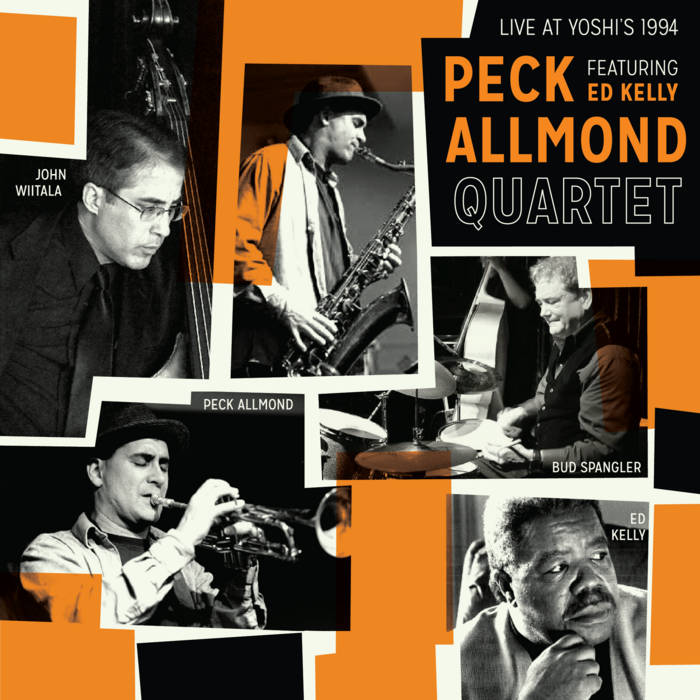
This past Sunday I wrote about my first encounter with Eastlawn Records. This is a Detroit-based blues and jazz label co-founded by percussionist RJ Spangler and pharmacist Frank Traum. This morning I encountered another Eastlawn release, whose full title (at least on its Bandcamp Web page) is Peck Allmond Quartet Live at Yoshi’s, ‘94 Featuring Ed Kelly.

As the title suggests, this is a recorded account of a performance at Yoshi’s in Oakland that took place on July 5, 1994. My wife and I did not make the move from Singapore to Palo Alto until about a year later; so, at the time this gig was recorded, we knew next to nothing about the Bay Area jazz scene. Furthermore, by way of a disclaimer, since we made that move in August of 1995, we have never attended a performance at either the Oakland Yoshi’s or the short-lived “cousin” in the Fillmore.

Thus, while I knew nothing about Allmond when this album was released, it did not take long for me to become aware of two members of his quartet. The first of these was drummer Bud Spangler (not to be confused with the Eastlawn founder), whom I quickly discovered on KCSM jazz programming. The other was bass player John Wiitala, who seemed almost always to handle the bass at any jazz concert presented under the auspices of Old First Concerts. Allmond himself was primarily a tenor saxophonist, although he shifted over to trumpet for two of the tracks on this album. The other member of his rhythm section was pianist Ed Kelly.

The concert also included a “guest appearance” by Kenny Brooks on tenor saxophone in a performance of Sigmund Romberg’s “Softly as in a Morning Sunrise.” (This was one of the two tracks on which Allmond played trumpet, the other being Chris Smith’s “Confessin’,” which became a favorite recording of both Fats Waller and Louis Armstrong.) The program also included two piano solos taken by Kelly, neither of which were originally conceived for piano. The first of these was John Coltrane’s “Moment’s Notice;” and the program closed out with a solo piano account of Miles Davis’ “All Blues.”

I would not be surprised if those that have been following my thoughts about jazz on this site would be quick to dismiss me as “old school.” While this may be true chronologically, I still find it hard to believe that anyone would call anything that Coltrane recorded for Impulse! Records as “old school,” not to mention the equally adventurous efforts of some of his contemporaries, such as Ornette Coleman or Cecil Taylor! The selections on this Yoshi’s album are certainly not out there on the “bleeding edge.” Nevertheless, there is no shortage of highly imaginative improvisation taken by all of the players; so I have no trouble stating categorically (and unabashedly) that this is jazz the way I like it.

Now that a recent high-rise has blocked my ability to receive KCSM in my San Francisco condominium, albums like this account of a Yoshi’s gig quickly become part of my regular jazz-listening practices.

Thursday, March 10, 2022

The Latest Homage Album for John Coltrane

This coming July 17 will mark 55 years since the death of jazz saxophonist John Coltrane. The fact that his legacy remains significant to both those that perform jazz and those that listen to performances reminds me of those days before I was born when jazz lovers “in the know” would be identified by the motto “Bix lives,” honoring the memory of jazz trumpeter Bix Beiderbecke. Ironically, both of these jazz icons died young: Coltrane at the age of 40 and Beiderbecke at the age of 28. Between those two figures was another major saxophonist that also died young, Charlie Parker at the age of 34.

Cover of the album being discussed (courtesy of Mouthpiece Music)

At the risk of sounding too fussy, I have to confess that, over the course of my own listening experiences, I have rarely encountered “memorial” performances of the music of any of those three jazz icons that left me with a sense of satisfaction. As digital signal processing technology kept getting better, it seemed as if present-day tributes never quite caught the spirit of how that music had been made in the past. I make this observation as a caveat regarding my thoughts about the latest Coltrane tribute album, Stretching Supreme, performed by a quartet formed by saxophonist Dave Wilson to reflect the “Classic Quartet” period in the Coltrane biography.

Coltrane played both soprano and tenor saxophone in that quartet, performing with McCoy Tyner on piano, Jimmy Garrison on bass, and Elvin Jones on drums. This marked a high point in the catalog of recordings produced by Impulse! Records, founded by Creed Taylor and drawing upon the engineering genius of Rudy Van Gelder. If the years of the Classic Quartet (1962–1965) marked some of Coltrane’s finest offerings, both originals and performances of standards, then the high point among those originals was the four-movement suite entitled A Love Supreme.

That composition inspired the title of Wilson’s new album, on which he also plays both soprano and tenor saxophone. Furthermore, he seems to have summoned three musicians willing to take Coltrane’s quartet as a point of departure for their own performances. Those musicians were Kirk Reese on piano, Tony Marino on bass, and Alex Ritz on drums. Ironically, however, the account of A Love Supreme seems to have more to do with compression, rather than stretching. Only the first two parts of the suite are performed, “Acknowledgement” and “Resolution,” along with a short introduction that precedes “Acknowledgement.” This truncation may have reflected the fact that the other three members of the original quartet make lengthier contributions to the remaining two parts; Wilson’s quartet players may not not been up to handling that level of inventiveness.

The fact is that, given that, in addition to the Impulse! studio recording, there are now two “live” recordings of Coltrane’s quartet playing A Love Supreme, the most recent having been released by Impulse! this past October, I fear that there is little to add or even reflect in an attempt to pay homage to this music. Nevertheless, readers may recall that, during the height of the pandemic, I was fortunate enough to encounter an album that radically rethought the music itself, rather than honoring its original creation. That rethinking was the product of guitarist Karl Evangelista, whose quartet included his Grex duo partner Rei Scampavia on keyboards along with Robert Lopez on drums and Dan Clucas on cornet. This struck me as a recording that found its own spirit in Coltrane’s conception, without worrying about, as I put it in writing about this album, “reproducing the ‘original flesh.’”

The good news is that Wilson’s album presents “live” performances of Coltrane’s music, recorded at Chris’ Jazz Café in Philadelphia. Those recordings include two other Coltrane selections, “Dear Lord” (another Classic Quartet offering) and “Naima” (from an earlier Atlantic session). They also include one of Wilson’s own compositions, “On the Prairie” and an account of Henry Mancini’s “Days of Wine and Roses,” neither of which is particularly compelling. Sadly, none of these offerings rise to the level of those past standards set by Impulse! Records.

Thursday, December 16, 2021

Harold Mabern at the John Coltrane Festival

Cover of the album being discussed

Smoke Sessions Records is the “house label” of the Smoke Jazz & Supper Club Lounge located in New York City a few blocks south of Columbia University. The club celebrates the end of the calendar year with an annual John Coltrane Festival that runs from the end of December to the beginning of January. Its latest release, Mabern Plays Coltrane, accounts for the final three nights of the festival on January 5, 6, and 7 of 2018.

On that occasion octogenarian jazz pianist Harold Mabern led a sextet with a front line consisting of Vincent Herring on alto saxophone, Eric Alexander on tenor saxophone, and Steve Davis on trombone. The other rhythm players were John Webber on bass and Joe Farnsworth on drums. Of the seven tracks on the album, six are Coltrane compositions. The other track is “My Favorite Things,” which, for many of us, is better known for Coltrane’s imaginative interpretation than for the original version composed by Richard Rodgers for The Sound of Music.

Mabern was a regular at Smoke, making it more than a little disappointing that he did not live to see the release of this album, having died at the age of 83 on September 17, 2019. Those 2018 performances are memorable for Mabern having found just the right sweet spot to honor some of Coltrane’s familiar idioms while inventing a fair share of his own. For example, the Coltrane version of “My Favorite Things” has become so familiar to informed jazz listeners that Mabern felt obliged to chart a new path to introducing the tune and then improvising on it.

On the other hand Mabern’s combo chose to honor the opening of “Blue Train” on the Blue Note album of the same name. This was also a sextet album, which featured Curtis Fuller on trombone. The close harmonies of the original recording were realized with trumpeter Lee Morgan joining Coltrane and Fuller. On Mabern Plays Coltrane, Morgan’s “soprano” line is taken by Herring. The blend is as convincing as ever, providing an “overture” for extended improvisations across the combo.

Indeed, one of the factors that makes this entire album interesting is the extent of space that Mabern allows for his front-line musicians. From that perspective one might suggest that Mabern is not as assertive as McCoy Tyner was in all of those sessions made for Impulse! Records. As a result, Mabern is neither a “primary” soloist nor a “rhythm” accompanist. Rather, the group is a “sextet of equals,” where the music allows each voice to have its appropriate say in the overall scheme of the entire album.

Mind you, for all of the tracks on this new release, I still expect to spend time revisiting my Coltrane albums; but the influence of Mabern’s sextet is likely to refine my listening practices.

Sunday, December 5, 2021

Impulse! Releases Newly-Discovered Coltrane

courtesy of Crossover Media

Among those that seriously collect recordings of jazz performances, particularly the “live” albums, one of the major events of this year (if not the major event) was the release by Impulse! Records of a new John Coltrane album: A Love Supreme: Live in Seattle. The suite A Love Supreme was originally recorded for Impulse! at a studio session on December 9, 1964. This became the major album of the John Coltrane Quartet, whose other members were McCoy Tyner on piano, Jimmy Garrison on bass, and Elvin Jones on drums.

Coltrane then took the entire suite on tour. Until this year, the only document of a tour performance involved a recording made in Antibes over the course of two days: July 26 and 27 of 1965. That recording also includes Coltrane’s “Impressions.” It was released in the United Kingdom by Charly Records and was subsequently released in 2002 by Impulse! as the second CD in a “Deluxe Edition,” whose first CD is the original studio recording.

This past October 22, however, Impulse! released its new album. This one was made after the tour during which the Antibes performance was recorded. However, the date of the performance, which took place at The Penthouse in Seattle, seems to be cited only as “late 1965.” What is particularly important is that the quartet expanded to include two additional saxophonists, Pharoah Sanders and Carlos Ward, and a second drummer, Donald Garrett.

Coltrane had already begun to expand the durations of the suite’s four movements, particularly through his own improvisations, while on tour. By the time of the Seattle recording, only the final movement, “Psalm,” was only slightly expanded. Each of the other three movements, “Acknowledgement,” “Resolution,” and “Pursuance,” is far more generous in its duration. Furthermore, the scope of the entire suite is further extended by four “Interlude” movements, the last two of which are two generous bass improvisations, presumably taken by Garrison and Garrett, respectively. There are also richer contributions from Jones, although those can also be found on the Antibes recording.

Back in the old days when vinyl ruled, I would have said that this new album would be welcomed by all those whose original discs had endured a needle wearing the tracks down to more noise than signal. Fortunately, content does not “wear down” in the digital age! Nevertheless, a document of performing before an audience tends to override one of a studio session. Mind you, I am still very much personally attached to my Antibes recording; but this Seattle release is just as welcome in my listening practices, particularly in providing yet another opportunity to listen to exchanges between Coltrane and Sanders.

Monday, November 15, 2021

Cornelius Boots Returns to Old First Concerts

Cornelius Boots (left) performing with Kevin Chen (from the O1C event page)

In June of 2020, Cornelius Boots was one of the early adopters in the live-streamed series of solo recitals presented by Old First Concerts (O1C). At that time Old First Presbyterian Church was under lockdown conditions; so, like other O1C recitalists that month, Boots performed in his own studio. Yesterday afternoon he returned to Old First Presbyterian, but it was unclear from the live-streamed account whether he was playing in the presence of an audience. He did, however, perform two of his selections with special guest artist Kevin Chen, who, like Boots, plays shakuhachi wind instruments of different sizes.

The first half of the program was devoted entirely to Boots’ original compositions. Two of these, both composed earlier this year, were designated as “live premiere” performances, meaning that they had first been performed only through streaming. The titles of these pieces were “Root Doctor” and “Wood Prophet,” both evoking the origins of the instruments he played. Between these two offerings, Boots gave the world premiere of “Wood God Blues,” which he had completed last year. This selection was inspired by Son House, one of the earliest of the delta blues musicians to have his performances recorded.

During the second half Boots’ primary contribution was a transcription of “Psalm,” the final movement of John Coltrane’s A Love Supreme suite. Boots’ evocation of Coltrane’s style was decidedly impressive, even if it was not as visceral as his approach to delta blues. Nevertheless, the transcription confined itself to the tenor saxophone line, while the music itself was created for a jazz quartet with rhythm provided by drums, bass, and piano. As a result, the notes of Coltrane’s part were noticeably undermined in the absence of the context in which they had been created.

Boots was at his most compelling playing his own music. His approaches to the blues-and-roots genre are as compelling as is his own double-meaning interpretation of “roots,” which accounts for the origins of his instruments. While there was much to appreciate in the duet he composed and played with Chen, in many ways the most satisfying listening experiences took place during the solo offerings in the first half of the program.

Saturday, September 4, 2021

Dave Liebman’s Latest Coltrane Tribute Album

courtesy of Lydia Liebman Promotions

Yesterday Dot Time Records released Selflessness: The Music of John Coltrane, the latest Coltrane tribute album to be recorded by saxophonist Dave Liebman (who was born 75 years ago today). Liebman leads his Expansions combo, created deliberately for reaching out to the younger generation. The group is a quintet, whose other four members are Matt Vashlishan on a diversity of winds, Bobby Avey on keyboards, Tony Marino on acoustic bass, and Alex Ritz on percussion. By way of “full disclosure,” I should note that I encountered this new album through Lydia Liebman Promotions, which is run by Dave’s daughter.

Given the broad account of his career that I found on his Wikipedia page, I feel somewhat embarrassed to have known so little about Liebman. What is important is that he was drawn to jazz as a result of going to Coltrane performances at New York City clubs such as Birdland, the Village Vanguard, and the Half Note Club. Given that he is less than two months younger than I am, my guess is that he was learning about Coltrane through the immediacy of performance at a time when I was just beginning to discover Coltrane albums.

The liner notes for this new album were written by Lewis Porter, whose book John Coltrane: His Life and Music has been a primary reference source for me ever since I devoured it cover-to-cover about four years ago. Porter graciously enumerates Liebman’s past Coltrane albums: Homage To John Coltrane, Joy, John Coltrane’s Meditations, and Lieb Plays the Blues á la Trane. By all rights, I should have been aware of Liebman and his attention to Coltrane long before I encountered Selflessness; but at my age little it to be gained from dwelling on things I might have done.

What matters more to me is Liebman’s current commitment to pass to the current generation the fruits of his extensive Coltrane experiences, first as a listener and then as a performer taking on the “Coltrane book.” I am particularly sensitive to the passing of this particular torch, because, back before I took up my current writing gig, I had to suffer through a painfully inept attempt at such a passing. The 2005 San Francisco Jazz Festival (organized by SFJAZZ) included a fortieth-anniversary performance of “Ascension,” which may have planted the first seed of my discontent with SFJAZZ. I cannot remember who the performers were; but it was clear to me at the time that none of them really understood what made “Ascension” tick, let alone what  made its recording such a monumental event in jazz history.

The good news about Selflessness is that Liebman clearly has a far more substantive sense of what makes the nine selections on this album tick. Sadly, this is my latest encounter with an Amazon.com Web page that does not provide a track listing. So I am obliged to let readers know specifically what those nine selections are:

  1. Mr. Day
  2. Compassion
  3. My Favorite Things
  4. Ole
  5. Lazy Bird
  6. Peace on Earth
  7. One Up One Down
  8. Selflessness
  9. Dear Lord

Through these nine compositions, Liebman has cultivated his Expansions band with more knowledge of how to perform Coltrane than I have ever encountered at an SFJAZZ event. From a more personal point of view, however, I found it very difficult to hold off a strong wave of nostalgia for “the real thing.” As a result, listening to this new album sent me back to my rather extensive collection of Coltrane recordings, simply because the new performances left me hungrier for the “source content” than I could have anticipated.

Now I find myself wondering whether or not Liebman provided listening sessions for the nine pieces he had selected, simply to introduce his fellow performers to some sense of what had drawn him to play jazz in the first place.