Showing posts with label Miles Davis. Show all posts

Saturday, January 11, 2025

Lisa Hilton’s Thirtieth Jazz Album

Some readers may recall that I last wrote about jazz pianist Lisa Hilton not much longer than a year ago, following up on the release for her quartet album Coincidental Moment. She led a quartet, whose other members were trumpeter Igmar Thomas, Luques Curtis on bass, and percussionist Rudy Royston. Most of the tracks were originals; but she also included “Blue in Green,” which may or may not have been composed jointly (but not necessarily in a partnership) by Miles Davis and Bill Evans.

Lisa Hilton on the cover of her latest album (courtesy of DL Media)

According to its Amazon.com Web page, her latest album, Lucky All Along, was released at the beginning of this past November. It is again a quartet album, and the members have not changed. Those that visit the Web site will see that the New York City Jazz Record honored this release as “one of the best albums of 2024” (apparently citing that encomium from All About Jazz). Once again, most of the tracks are originals; but this time there is a track that can definitely be attributed to Davis, “All Blues.” As might be expected, Thomas gets a generous amount of solo playing for it; and I, for one, am delighted with how he “found his own voice” without trying to channel the composer’s performances.

Nevertheless, where Hilton’s own tracks are concerned, I fear that there was little to urge me to sit up and take notice. I am reminded of what I wrote about a similar jazz quartet in September of last year:

My guess is that, if I had seen this group perform at Mr. Tipple’s Jazz Club in an experience enhanced by good food, drink and even dessert, I would have come away with the impression that it was an evening well spent. Nevertheless, on the album none of the tracks leaves much an impression, whether it involves the tune itself of its capacity for improvisation.

Perhaps this is just a matter of age kicking in on my capacity for appreciation.

The bebop era was one of revolutionary changes, which can still be appreciated through attentive listening to the many tracks recorded by the likes of Charlie Parker and Dizzy Gillespie. However, when I was growing up, bebop gave way to third stream, which felt too much as if the intellectual was shoving the visceral into the background. Now it almost seems as if jazz has devolved into a “genre of nostalgia” with new tunes reflecting back on old styles; and that pretty much accounts for how I react to Hilton’s originals.

I wish it were otherwise, but I have come to fear that any vivacity in the spirit of jazz may be succumbing to “old age,” just like that generation of jazz masters that that flourished in the last decades of the last century.

Monday, October 21, 2024

Recording of Steve Davis Sextet Coming Friday

This Friday will see the release of a new jazz sextet album led by trombonist Steve Davis. The seven tracks account for a live performance at the Smoke Jazz Club, located in Manhattan at the corner of 106th Street and Broadway (renamed as Duke Ellington Boulevard). The other members of the sextet are trumpeter Eddie Henderson, Ralph Moore on tenor saxophone, pianist Renee Rosnes, Essiet Essiet on bass, and drummer Lewis Nash. As is almost always the case, Amazon.com has already created a Web page for taking pre-orders.

Cover of the album being discussed (from its Amazon.com Web page)

The title of the album, produced by Smoke Sessions Records, is We See, which is a deliberate nod to Thelonious Monk. It should go without saying that this is one of the seven tracks. Other familiar tracks include “Milestones” (Miles Davis), “Up Jumped Spring” (Freddie Hubbard), “Star Eyes” (Gene de Paul and Don Raye), “Ask Me Now” (Monk again), and “All Blues” (Miles Davis again). However, the stand-out track is an homage to pianist Larry Willis with his “To Wisdom, The Prize.” Willis died in 2019, and he had been one of Davis’ closest collaborators. Thus, there is a strong personal context for the tracks that Davis prepared for this album.

These days I sometimes feel as if I am part of a dying breed that still grooves on straight-ahead jazz. Yes, I can appreciate musicians that boldly go where no improvisers have gone before; but my preferences still turn to those that can spin out inventive takes on past tropes. This is an album of tracks from the past; but the performances are, without a doubt, vividly in the immediate present!

Wednesday, April 10, 2024

Brian Bromberg’s Tribute to Scott LaFaro

Brian Bromberg with his bass (photograph by Michel Bocande, courtesy of DL Media)

This past Friday Be Squared Productions released a new album featuring bass player Brian Bromberg. The title of the album is LaFaro, and those familiar with the many recordings released by pianist Bill Evans will recognize this as a tribute to Scott LaFaro, who was a major contributor to the inventiveness of the Bill Evans Trio in which he played. Mind you, Evans is acknowledged in his own right only by the second track on the album, “Waltz for Debby.” (I’ve lost track of the number of times that Evans recorded that tune!)

Miles Davis, on the other hand, is acknowledged through four tracks (in “order of appearance”): “Solar,” “Blue in Green,” “Milestones,” and “Nardis.” Those that are historically inclined probably know that “Solar” dates all the way back to his sessions for Prestige Records. It was recorded about a year and a half before Davis formed his quintet with John Coltrane. (The bass played in that quintet was Paul Chambers. According to my sources, LaFaro never played or recorded with Davis.) Nevertheless, one might wish to conclude that Evans (by way of LaFaro) was the stronger influence in creating the “program” for the LaFaro album. If for no other reason, he recorded “Waltz for Debby” four times during his tenure with Riverside!

At this point I should make the disclaimer that, while I often appreciate “tribute” albums such as LaFaro, they always send me burrowing through my own collection to dig up earlier sources for at least some of the tracks! That said, there is more than enough inventiveness on Bromberg’s new release to allow one to appreciate its own merits. I suspect that I am particularly drawn to listening to jazz piano trios because, when they exercise the full extent of individual inventiveness, their merits are up there with those of the classical music piano trio.

Regarding the album itself, the above hyperlink leads the reader to the Web page for purchasing the Audio CD. However, those that follow the link to the MP3 Web page will be in for a treat. In addition to all twelve of the tracks on the CD, there are three “bonus” tracks. One of them provides another Evans selection, “Peri’s Scope.” According to his Wikipedia page, this was named after Peri Cousins, described as the object of “Evans’s first long-term romance.” If I am following the dates on that page correction, that romance was over by the time LaFaro began to make recordings with Evans in the early Sixties! On the other hand, “Peri’s Scope” was one of the first tunes that LaFaro recorded with Evans (at a session on December 28, 1959)!

Monday, May 22, 2023

Bruno Råberg’s First Solo Bass Album

Bruno Råberg with his instrument (photograph by Janis Wilkins)

This past Friday Orbis Music released a solo album by bass virtuoso Bruno Råberg entitled simply Look Inside. Most of the album is devoted to Råberg’s own compositions and improvisations; but there are three notable exceptions, all of which may be regarded as “jazz classics” from the twentieth century. In “order of appearance,” they are “Nardis” (composed by Miles Davis in 1958), “Prelude to a Kiss” (composed by Duke Ellington in 1938), and “My Man’s Gone Now,” from George Gershwin’s opera Porgy and Bess, composed in 1935.

At this point I should make a disclaimer that, here in San Francisco, I have had more than generous opportunities to listen to bass work in both the classical and jazz genres. My most frequent source has been Scott Pingel, Principle Bass for the San Francisco Symphony. When he has not been at his “day job,” I have had the good fortune to listen to his solo performances in both of those genres, including an ingenious mash-up bringing together one of Johann Sebastian Bach’s solo cello preludes with “Stella by Starlight.” Such a rich listening experience will clearly influence my approach to other solo bass performances.

Thus, after several encounters with Look Inside, I have not yet been able to get particularly excited. Nevertheless, I think it would be a mistake to attribute any shortcomings to Råberg. The fact is that giving the low register its due is a tall order for audio technology, whether it involves the ability of the capture gear to accommodate low frequencies or the shortcomings that arise through the content of a CD and the adequacy of the audio gear (particularly the speaker system) realizing that content.

In other words I would not be surprised if there were more subtleties in Råberg’s music-making than could “meet the ear.” He currently teaches at the Berklee Global Jazz Institute, one of the divisions of the Berklee College of Music in Boston. It would not be out of the question for the San Francisco Conservatory of Music to invite him for one of their one-week residencies, during which he would divide his time between teaching and performing with both students and faculty. That would give those of us on “the other coast” the opportunity to appreciate his efforts without any interference from technological shortcomings.

Thursday, May 18, 2023

Marina Pacowski Scats with the Best of Them

This past March, Summit Records released Inner Urge, an album featuring French vocalist Marina Pacowski. If her scat singing has not yet ascended to the heights of Ella Fitzgerald at her most inventive, Pacowski shows sign of achieving that elevation. The only downside to her vocal work involves singing lyrics, not only in English but also in her native French. The timbre tends to be “top-loaded” with an excess of upper harmonics, leading to sonorities that are more evocative of Betty Boop (or Helen Kane, who inspired Boop’s creation by Fleischer Studios) than of Fitzgerald.

The good news is that, when Pacowski’s singing falls short of the mark, her accompanying instrumentalists fill in with their own imaginative improvisations. The bad news is that, at least according to the information on the Amazon.com Web page, the album does not have either a back cover or a booklet, meaning that there is no good way to keep track of which instrumentalists are playing what. On the other hand, the only serious lack of background information involved Pacowski’s scat improvisations for “Donna Lee,” which may (or may not) have been inspired by Charlie Parker or Miles Davis or both. Sadly, this is one of the shortest tracks on the album; but it is definitely worth the price of admission!

Sunday, January 29, 2023

Zoran Dukić’ Solo Recital for Omni

Croatian guitarist Zoran Dukić (courtesy of the Omni Foundation for the Performing Arts)

As was announced at the beginning of this month, last night the Omni Foundation for the Performing Arts presented the first of the four solo recitals in its Dynamite Guitars series. The recitalist was the Croatian classical guitarist Zoran Dukić, who was last seen in the premiere of a recital video, which was released by Omni this past August. Last night’s program was an inventive one, exploring an engaging diversity of repertoire sources.

The first half was devoted entirely to an interleaving of Johann Sebastian Bach and Astor Piazzolla. The “spinal cord” of the set consisted four movements from the collection of Bach’s sonatas and partitas for solo violin. In “order of appearance” these were as follows:

  1. The Siciliana from the BWV 1001 sonata in G minor
  2. The Andante from the BWV 1003 sonata in A minor
  3. The Largo from the BWV 1005 sonata in C major
  4. The Sarabanda from the BWV 1004 partita in D minor

Between these offerings were the three Piazzolla compositions:

  1. “Invierno Porteño,” the second (winter) “season” in Las Cuatro Estaciones Porteños, which Piazzolla originally composed for his own tango band and was arranged for solo guitar by Sérgio Assad
  2. “Adio Nonino”
  3. “La Muerte del Angel” in an arrangement by Leo Brouwer

These seven pieces were played without interruption, providing an engaging sense of a unified whole.

The second half of the program returned to Piazzolla with “Oblivion” in another arrangement, this time by Roland Dyens. This was preceded by three selections, beginning with Dušan Bogdanović’s “Lament” followed by “Choro da Saudade” and “Caazapá,” both by Agustín Barrios. The program concluded with Cinema Paradiso by Stephen Goss, a suite of six movements, each evocative of some aspect of cinematic history. Dukić took a single encore, which I think was his own arrangement of Duke Ellington’s “Melancholia.”

Taken as a whole, the recital was imaginatively informed and consistently engaging. I found Goss’ suite to be a bit contrived, but I still enjoyed his “Noir” movement. This was a nod to Miles Davis, who provided the music cues for Louis Malle’s film Elevator to the Gallows. However, the interplay between Bach and Piazzolla was definitely the high point of the evening.

Thursday, October 6, 2022

Storyville Releases Solo Petrucciani Album

One of my greater regrets has been the paucity of opportunities to listen to the jazz piano work of Michel Petrucciani that have come my way. According to my archives, I have written about only one album documenting a performance. The title of that album was One Night in Karlsruhe, documenting a live broadcast made by Süddeutscher Rundfunk on July 7, 1988. I wrote about that album on the date of its release over three years ago, January 11, 2019. This was a trio performance with Gary Peacock on bass and Roy Haynes on drums providing rhythm for Petrucciani.

I shall not repeat the biographical background material concerning Petrucciani’s genetic disease and his early death at the age of 36 on January 6, 1999. Since One Night in Karlsruhe provided my first opportunity to write about Petrucciani, I was generous in providing background. Those unfamiliar with that background can follow the hyperlink in the preceding paragraph.

courtesy of Naxos of America

A little over a month ago Storyville released a new album entitled Solo in Denmark. It documents the solo set that Petrucciani performed for the Silkeborg Riverboat Jazz Festival in Denmark on June 23, 1990 in the Silkeborg Church. The tracks include two Petrucciani originals, “P’tit Louis” and “She Did it Again.” Thelonious Monk receives the same amount of “track attention” with Petrucciani’s unique interpretations of both “Round Midnight” and “Blue Monk.” There is also a track for Bruno Martino’s “Estate,” composed in 1960 and receiving a generous amount of attention from a diverse assortment of jazz players during the ensuing decade. Those performers included Chet Baker and Monty Alexander. The final track of the album appears to be Petrucciani’s encore selection, a medley that combines several favorite standards with a few of “Miles Davis’ Licks” (as described on the back cover of the album).

While the opening two tracks run for only a little more than five minutes, the following four run between seven and eight and a half minutes. One of these is the “Round Midnight” track. Given how many times this was recorded by Monk himself, each with its own improvised licks, one has to be drawn to the amount of original invention that Petrucciani brought with him on his visit to Denmark. This involves several ambitious (if not a bit disorienting) ventures into off-beat rhythms that establish Petrucciani’s capacity for unique interpretation.

Petrucciani was fortunate enough to establish his reputation during the final quarter of the last century. If one evokes the standing-on-the-shoulders-of-giants metaphor (without being demeaning of Petrucciani’s own physical stature), 1975 offered up an impressive diversity of those shoulders, including Thelonious Monk, Miles Davis (including both of his quintets), and John Coltrane. Petrucciani clearly exploited the benefits of history, which then equipped him to establish his own inventive paths. Solo in Denmark provides the attentive listener with the opportunity to experience and appreciate the diverse scope of those paths.

Monday, September 5, 2022

Mike Greensill Brings Trio for O1C Tradition

Late yesterday afternoon jazz pianist Mike Greensill returned to the altar of the Old First Presbyterian Church to present his annual Labor Day Weekend performance for Old First Concerts (O1C). Last year he was joined only by Ruth Davies on bass; and, as I put it at the time, the two of them “were separated by more than the currently recommended distance.” This year he led a trio with Davies on bass and Brad Buethe on guitar. The last four selections featured guest vocalist Gail Terminello.

The program consisted of the usual balance between Greensill originals and “high standards” to draw upon the title Greensill selected for the afternoon. This time around I was particularly struck by an interesting parallel with last year. On that occasion Greensill served up an intimate verbal introduction for the performance of Miles Davis’ “Blue in Green.” This time the “spirit of Miles” was right there at the beginning of the program, not with one of his compositions but with a take on a favorite selection from his “book,” “On Green Dolphin Street,” which Bronisław Kaper originally composed for the film Green Dolphin Street.

As usual, there was a generous number of Greensill’s compositions on the program. This time I realized that I probably had not heard any of those pieces at a previous Labor Day performance. Given the number of these gigs that I have attended over the years, I am beginning to think that Greensill’s catalog is much larger than I had ever thought!

Mike Greensill, Gail Terminello, Ruth Davies, and Brad Buethe performing the Old First Concerts annual Labor Day offering (screen shot from the video being discussed))

Once again, there were problems for those of us watching the streamed version. Fortunately, these did not involve the synchronization glitches that plagued last year’s program. This time the video matched the audio with clear accounts of all three of the instruments. The only problem was that the microphone for Greensill’s vocals and introductions was not mixed into the other sources. This made audibility difficult, more for his speaking voice, since his singing blended in well with his accompanying partners. Since Terminello delivered her vocals from the front of the altar with her own microphone, properly distanced from the musicians, the audio signal for her singing was perfectly satisfactory (even if her style was not one of my preferences).

Sunday, August 21, 2022

Mitropoulos and American Composers

My journey through Sony Classical’s Dimitri Mitropoulos: The Complete RCA and Columbia Album Collection concludes with an account of his performances of music composed in the United States. Note that I did not write “music by American composers.” Thanks to Adolf Hitler, the United States saw a significant influx of European composers trying to escape the Nazi juggernaut. Many of them were particularly forward-looking, and I am one that believes that our country was very fortunate enough to have Arnold Schoenberg as one of them.

I might even go as far as to say that Schoenberg was as prolific after arriving in the United States as he was before leaving Europe. Indeed, one the best examples of how he applied his twelve-tone technique is his Opus 36 violin concerto. He dedicated this concerto to his former student Anton Webern (who did not make the “transatlantic move” and suffered the consequences).

The concerto was given its world premiere by the Philadelphia Orchestra conducted by Leopold Stokowski. The soloist was Louis Krasner, who had worked closely with Alban Berg on the composition of his violin concerto. Mitropoulos recorded this concerto with the New York Philharmonic, and Columbia released it on an album that also included the Berg concerto. Krasner was the soloist for both concertos, but the Berg concerto was performed by the Cleveland Orchestra led by Artur Rodziński. This is definitely a must-listen album for those interested in the work of Schoenberg and his students (even if Mitropoulos occupies only half of the CD).

A related composer from Schoenberg’s time in Vienna, who also made the move to the United States, is Ernst Krenek. While Krenek was never part of the “Schoenberg school,” he had his own approaches to innovation. Mitropoulos recorded his “Symphonic Elegy,” which was composed in memory of Webern’s tragic death and was scored for string orchestra. Columbia coupled this with Schoenberg’s Opus 17 “Erwartung,” which had been previously performed in Europe. Mitropoulos recorded the performance with soprano soloist Dorothy Dow, making this CD another “must listen” album.

There is also an opportunity to listen to the work of one of Schoenberg’s finest American pupils. Leon Kirchner studied with Schoenberg at the University of California in Los Angeles. After his graduate studies at the Berkeley campus, he pursued both composing and an academic career. He composed his piano concerto on a commission from the Koussevitzky Foundation, and he completed it in 1953. The recording was made with support from the Naumburg Foundation. Kirchner himself performed the solo piano part with Mitropoulos and the New York Philharmonic.

Curiously, there is only one other American-born composer that seems to have attracted much of Mitropoulos’ attention. That is Morton Gould, who composed the music for Agnes de Mille’s ballet about Lizzie Borden, which was entitled “Fall River Legend” and was first performed by American Ballet Theatre in April of 1948. Gould extracted a suite from his score, which Mitropoulos recorded with the New York Philharmonic. Mitropoulos also recorded two “singles” of Gould’s music. “Philharmonic Waltzes,” which (obviously) was performed by the New York Philharmonic, was also composed in 1948. (The CD couples this with Roger Sessions’ second symphony and Elie Siegmeister’s suite Ozark Set.) However, there is also an earlier (1946) Gould composition entitled “Minstrel Show,” which Mitropoulos recorded during his tenure in Minneapolis.

The other American-born composer of significance is Samuel Barber. Mitropoulos conducted the premiere of Barber’s Opus 32 four-act opera Vanessa, which was performed by the Metropolitan Opera. This opera has enjoyed several revivals, one of which I remember seeing on television. Still, this “original cast” recording remains refreshing with Eleanor Steber in the title role and Nicolai Gedda as Anatol.

Finally, it is worth noting that Mitropoulos shared an album with Gunther Schuller entitled Music for Brass. The selections on this album were performed by The Brass Ensemble of the Jazz and Classical Music Society, reflecting Schuller’s interest in a synthesis of the two genres. Mitropoulos contributed to the album by conducted Schuller’s “Symphony for Brass and Percussion.” The result was not particularly jazzy, but the production of the album provided a platform for forward-looking jazz players such as Miles Davis and J. J. Johnson.

Tuesday, May 31, 2022

A Recent Album Recorded at Yoshi’s

from the Bandcamp Web page

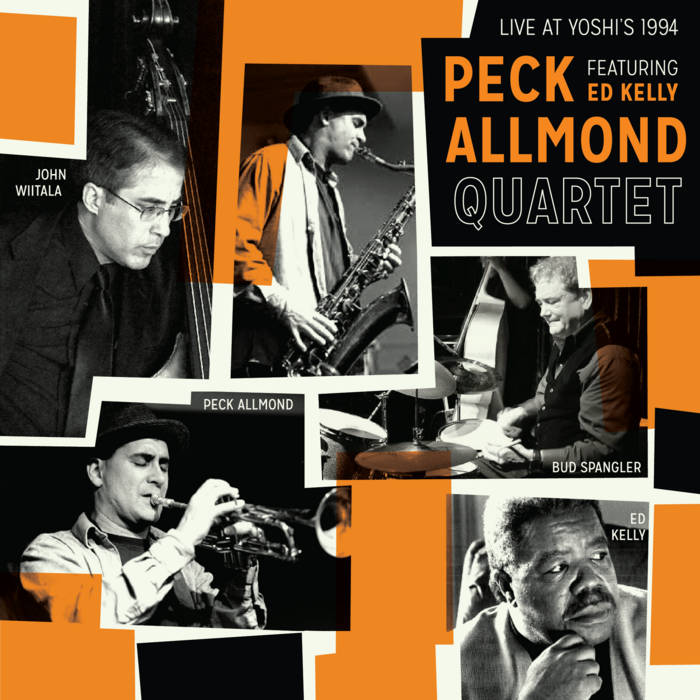
This past Sunday I wrote about my first encounter with Eastlawn Records. This is a Detroit-based blues and jazz label co-founded by percussionist RJ Spangler and pharmacist Frank Traum. This morning I encountered another Eastlawn release, whose full title (at least on its Bandcamp Web page) is Peck Allmond Quartet Live at Yoshi’s, ‘94 Featuring Ed Kelly.

As the title suggests, this is a recorded account of a performance at Yoshi’s in Oakland that took place on July 5, 1994. My wife and I did not make the move from Singapore to Palo Alto until about a year later; so, at the time this gig was recorded, we knew next to nothing about the Bay Area jazz scene. Furthermore, by way of a disclaimer, since we made that move in August of 1995, we have never attended a performance at either the Oakland Yoshi’s or the short-lived “cousin” in the Fillmore.

Thus, while I knew nothing about Allmond when this album was released, it did not take long for me to become aware of two members of his quartet. The first of these was drummer Bud Spangler (not to be confused with the Eastlawn founder), whom I quickly discovered on KCSM jazz programming. The other was bass player John Wiitala, who seemed almost always to handle the bass at any jazz concert presented under the auspices of Old First Concerts. Allmond himself was primarily a tenor saxophonist, although he shifted over to trumpet for two of the tracks on this album. The other member of his rhythm section was pianist Ed Kelly.

The concert also included a “guest appearance” by Kenny Brooks on tenor saxophone in a performance of Sigmund Romberg’s “Softly as in a Morning Sunrise.” (This was one of the two tracks on which Allmond played trumpet, the other being Chris Smith’s “Confessin’,” which became a favorite recording of both Fats Waller and Louis Armstrong.) The program also included two piano solos taken by Kelly, neither of which were originally conceived for piano. The first of these was John Coltrane’s “Moment’s Notice;” and the program closed out with a solo piano account of Miles Davis’ “All Blues.”

I would not be surprised if those that have been following my thoughts about jazz on this site would be quick to dismiss me as “old school.” While this may be true chronologically, I still find it hard to believe that anyone would call anything that Coltrane recorded for Impulse! Records as “old school,” not to mention the equally adventurous efforts of some of his contemporaries, such as Ornette Coleman or Cecil Taylor! The selections on this Yoshi’s album are certainly not out there on the “bleeding edge.” Nevertheless, there is no shortage of highly imaginative improvisation taken by all of the players; so I have no trouble stating categorically (and unabashedly) that this is jazz the way I like it.

Now that a recent high-rise has blocked my ability to receive KCSM in my San Francisco condominium, albums like this account of a Yoshi’s gig quickly become part of my regular jazz-listening practices.

Thursday, April 14, 2022

Uninterrupted Hour of Straight-Ahead Jazz

courtesy of Play MPE

The beginning of this month saw the release of the latest album of jazz pianist Jean-Michel Pilc, born in Paris and now living in Montreal. Alive – Live at Dièse Onze, Montréal is, as the title suggests, a concert recording from a club in that city. Pilc leads a trio, whose other members are Rémi-Jean LeBlanc on bass and Jim Doxas on drums. The album has five tracks; but the five selections were performed seamlessly with transitions that were barely audible (if they were audible at all).

The five selections are as follows:

  1. Softly, as in a Morning Sunrise (Sigmund Romberg)
  2. 11 Sharp (the first of two Pilc originals)
  3. Nardis (Miles Davis)
  4. All Blues (also Davis)
  5. Alive (the title track and second Pilc original)

The audience for this gig clearly “got” that sense of seamless continuity that Pilc intended: If there were sounds from anyone other than the musicians, they were barely audible.

While the performance was highly focused, there was no shortage of playful disposition. Through his improvisations, Pilc can take even the most familiar tunes into unknown territory; and both LeBlanc and Doxas had no trouble staking out that territory with their own improvisations. “11 sharp” presumably refers to a rigidly-defined time at which something important would begin or end. Pilc’s performance amounted to an exploration of the restlessness that comes when one is waiting to that moment to arrive. Personally, however, I was glad to encounter a take on the Davis selections, unfolding original improvisations rather than honoring the music’s “classic” status.

Presumably, the attentive listener with a serious interest in inventive jazz will come away from this hour-long listening experience with the same satisfaction enjoyed by Pilc’s audience.

Wednesday, April 6, 2022

Ébène Presents Chamber and Jazz in One Gig

Ébène Quartet members Raphaël Merlin, Pierre Colombet, Marie Chilemme, and Gabriel Le Magadure (photograph by Julien Mignot, courtesy of SFP)

Last night the Ébène Quartet (Quatuor Ébène) returned to San Francisco to give its fourth San Francisco Performances concert. In the past they have performed in both the Jazz Series and the Chamber Series. In the absence of a Jazz Series this season, they prepared a program for the Shenson Chamber Series that presented string quartets by Joseph Haydn and Leoš Janáček in the first half and then provided a jazz gig for the second. Originally an all-male ensemble, the group used to cultivate a “bad boy” image, such as the photograph taken by La Jungle for the inner pages of their Fiction CD:

Ébène Quartet founders Mathieu Herzog, Raphaël Merlin, Pierre Colombet, and Gabriel Le Magadure

This did not always go down well with some of their chamber music performances. However, when violist Marie Chilemme replace Colombet, things tended to sober up a bit; and Chilemme seems to have satisfied a need for focus that has served both chamber and jazz offerings equally well.

This was particularly important on the jazz side, for which all selections were announced from the stage by Merlin. Indeed, Merlin credited the arrangements for the first two selections, Wayne Shorter’s “Footprints” and Miles Davis’ “Milestones,” to the Turtle Island String Quartet. Merlin went as far as to acknowledge Turtle Island with inspiring Ébène to move into the jazz genre. Since I still have my copy of the first CD that Turtle Island released, I appreciated their being cited as much as the techniques through which Ébène cultivated their “responses” to the “call” of Turtle Island.

According to my records, two of the jazz offerings in this portion of the program had previously been performed here as encore selections. These were “Ana Maria” (Shorter again) and “Libertango” by Astor Piazzolla. However, given the current political climate, the most timely selection was their decision to play Charles Mingus’ “Fables of Faubus.”

My guess is that there is now at least one generation of listeners that do not appreciate the significance of that title. It refers to Orval Faubus, who was governor of Arkansas in 1957, when he called out the National Guard to prevent nine African American teenagers from entering Little Rock Central High School. Mingus wrote words to go with this tune (including “Two, four, six, eight: They brainwash and teach you hate.”); but Ébène provided a music-only account. (For that matter, Columbia Records would not allow Mingus and Dannie Richmond to sing them at their recording session.)

The chamber music selections were equally engaging and, perhaps, even a bit provocative. The Haydn selection was the Hoboken III/34 quartet in D major, the fourth of the six quartets published as Opus 20. These were the first quartets in which Haydn began to explore adventurous (and occasionally provocative) approaches to composing for string quartet. Ébène easily negotiated the many twists and turns of Haydn’s inventiveness, making for a delightful edge-of-your-seat listening experience.

This was followed by Leoš Janáček’s first quartet, given the name “Kreutzer Sonata” based on the novella of that title by Leo Tolstoy. Tolstoy’s tale is one of an “eternal triangle,” which made it interesting that the quartet membership should have one woman (the unfaithful wife in Tolstoy’s narrative) and three men (husband, lover, and narrator). However, the music itself is not narrative in nature. Rather, each of the four movements reflects on the intense shadows behind each of the episodes in Tolstoy’s tale. Ironically, all of these episodes unfold at the same “Con moto” tempo; but each one discloses its own palette of emotional dispositions.

Mind you, the same can be said of the expressiveness of all of the offerings in the entire Ébène program!

Tuesday, September 14, 2021

Further Reflections on Antonio Adolfo

My first encounter with a recording of Brazilian jazz pianist Antonio Adolfo was not a particularly conducive one. He had released Rio, Choro, Jazz: a tribute to legendary Brazilian pianist & composer Ernesto Nazareth on his own AMM (Antonio Adolfo Music) label through CD Baby in March of 2014, back when I was writing for Examiner.com; and I was skeptical about whether he had caught Nazareth’s spirit in his music. Mind you, my knowledge of Nazareth was heavily influenced by the appropriation of his music by Darius Milhaud; but, as I put it at the time, I came away from Adolfo’s treatments as “more readily classified as ‘smooth jazz’ than as ‘gritty Brazilian.’”

However, since the movement to my current site, I have found myself more sympathetic to more recent AMM albums, Samba Jazz Alley, which was basically a tribute to Rio de Janeiro as the birthplace of Brazilian jazz, and, this past July, Jobim Forever, focusing on the impact of Rio-based jazz master Antônio Carlos Jobim. As a result, I decided to continue to pursue my interest in Adolfo’s recordings by going back to two earlier releases, Encontros, which features the large ensemble Orquestra Atlantica, and BruMa: Celebrating Milton Nascimento. Encontros is the earlier album, released in November of 2018 and, as of this writing, only available for download or streaming through Amazon.com. BruMa then followed in June of last year.

“Encontros” is Portuguese for “meetings,” and it reflects influences of the Atlantic Ocean serving as the east coast of both South and North America and the west coast of the Iberian peninsula and Africa. North American influences are particularly interesting, since they include Miles Davis’ “Milestones” and Adolfo’s own “Partido Samba-Funk.” Equally appealing is the three-way meeting entitled “Africa Bahia Brasil,” as well as “Capoeira Ya,” which puts a flamenco twist on a Brazilian dance based on a martial art. Adolfo was clearly comfortable working with a large ensemble, drawing upon arrangements and orchestrations that were prepared by Jessé Sadoc and Marcelo Martins.

BruMa, on the other hand, had educational value for me. While I was familiar with a fair number of Jobim tunes, I basically knew Nascimento only by name. Ten tracks of his compositions seemed to be a good way for me at least to begin to fill that gap. My education was facilitated by a useful set of liner notes by Chris McGowan. Those preferring to download this album through the Amazon.com Web page should, however, be warned that the booklet is not included as part of the download. Fortunately, the liner notes can be found on a Web page on the AAM Web site.

Monday, September 6, 2021

Audience Returns to Greensill’s O1C Tradition

A year ago jazz pianist Mike Greensill did not let pandemic conditions disrupt his traditional Labor Day weekend performance for Old First Concerts (O1C). He came to the altar of the Old First Presbyterian Church along with John Wiitala on bass. They were separated by more than the currently recommended distance; but neither of them wore a mask, probably because cues were given through facial expressions. Except for the video crew that captured the performance, the church itself was empty.

Yesterday Greensill returned to Old First. As readers may know by now, O1C is admitting a downsized audience. However, the program was still live-streamed; and that was the way I experienced it. Greensill was again accompanied only by a bassist, this time Ruth Davies.

As usual, there was a balance of Greensill originals and standards. Also as usual, Greensill introduced each piece with engaging (and sometimes extended) personal commentary. It would be fair to say that his remarks were as richly improvised as his keyboard work.

One of his most intimate introductions had to do with the performance of Miles Davis’ “Blue in Green.” He reflected affectionately on his first encounter with Davis’ Kind of Blue album. At the time he had been pretty much locked into jazz from the Thirties, and I would guess that he never took to bebop and many of the more aggressive styles that followed it. Davis had already released Birth of the Cool about two years before Kind of Blue, and Greensill confessed to being taken with the emergence of the cool jazz movement.

Indeed, there tended to be a wistful sense of the cool that permeated the generous number of styles that Greensill worked into his program with Davies. The rhetorical stance worked for them, even when they went all the way back to Fats Wallers’ “Honeysuckle Rose” and all the way forward to Greensill’s own take on the Latin style. The latter was the perfect example of Greensill playing with his titles. The piece was called “A Minor Latin Tune;” and the key was (of course) A minor.

For those (like myself) who chose streaming over physical presence, however, there was a major problem. The soundtrack was not properly synchronized with the video. O1C ran into this problem a year ago, during the early days of producing video streams. However, the technical work improved with experience; and those improvements were evident last month when O1C was one of the hosts for the fifth annual season of the San Francisco International Piano Festival.

Yesterday afternoon, however, marked some significant backsliding. Both instrumentalists were not shy in taking a physical approach to performing on their respective instruments. In Greensill’s case that entailed an impressive command of the full breadth of his keyboard. As a result, when one heard high-register punctuations while watching his hands busy on the low-register side, it was clear that there were “technical problems.” When keyboard work gets elaborate, many concert-goers will stare intently at the keyboard while wondering about the pianist “Just what is (s)he doing and how is (s)he doing it?” When poor video technique forces the eyes to deal with noise, rather than signal, the whole listening experience is irreparably damaged.

Thursday, April 22, 2021

Opera Parallèle to Celebrate Earth Day with Jazz

Banner for this evening’s recital (from its Opera Parallèle event page)

Tonight Opera Parallèle will celebrate Earth Day with its second free recital in its Close-Up series. This will be a jazz duo program featuring soprano Tiffany Austin joined by Marcus Shelby on bass. Acknowledgement of Mother Earth will include the spiritual “Down by the Riverside” and, a bit more explicitly, Björk’s “Oceania.” These will be preceded by Miles Davis’ “All Blues” with Austin singing the lyrics added by Oscar Brown Jr. The spirit of activism behind Earth Day will then be acknowledged in the final selection, Shelby’s own composition “I Will Not Stand Still.”

This recital will be live-streamed this evening, April 22, at 5 p.m. Hyperlinks for both Facebook and YouTube will be posted on the Opera Parallèle event page this afternoon at 3:30 p.m. That Web page also includes a sign-up hyperlink, allowing those links to be received in an electronic mail reminder, which will be sent at 4 p.m. (one hour prior to the beginning of the performance). The full performance will be available on-demand until Thursday, May 20, at 5 p.m.

Friday, March 19, 2021

Vista Records Releases Latest Mabuchi Album

Yuko Mabuchi at the piano (courtesy of Blujazz Promotions and Booking)

I first became aware of Japanese jazz pianist Yuko Mabuchi this past August when Yarlung Records released her trio album Yuko Mabuchi Plays Miles Davis. This was a concert recording taken from a performance in Cammilleri Hall on the campus of the University of Southern California, and her trio colleagues were Del Atkins on bass and Bobby Breton on drums. Not too long after this encounter, Vista Records, which had produced Mabuchi’s first two CDs in 2011 and 2014, respectively, released her latest album, a two-CD set entitled simply Yuko. This was another concert recording, this time of a performance by the same trio at the Vibrato Jazz Club in Los Angeles, where Mabuchi has been living since 2016.

This is a far more diverse album than the Davis tribute offering. However, within that diversity, the listener will encounter new approaches to two of the tracks from that earlier recording, “All Blues” and “So What,” both of which are undisputed Davis “classics.” Both of these, of course, are best associated with the Kind of Blue album that Davis made with John Coltrane; and this new release gives a nod to one of Coltrane’’s most memorable compositions, “Giant Steps.” Mind you, the intervallic leaps suggested by the title are less imposing for a keyboardist; and Atkins’ work on bass guitar establishes a funkier rhetoric than one finds on Coltrane’s Giant Steps album. However, this simply reinforces the premise that Mabuchi and her trio know how to bring perfectly valid new approaches to past compositions that have attained “classics” status!

The fact is that Mabuchi drew upon an impressively wide diversity of sources in preparing for this particular concert gig. George Gershwin is there with “I Got Rhythm” but so is Antônio Carlos Jobim with “Só Danço Samba” (to which Mabuchi adds her own vocal work). Then, for “something completely different,” she ventures into Stevie Wonder’s “Isn’t She Lovely” and “Ain't No Mountain High Enough” by the Motown “dynamic duo” of Nickolas Ashford and Valerie Simpson. There are also a few nods to Mabuchi’s origins with both traditional and pop selections from Japan.

What is interesting, however, is that, to the best of my knowledge, none of the sixteen tracks in this collection originated in a jazz trio led by a pianist with bass and percussion. Mabuchi’s performances are not just a matter of drawing upon familiar tunes from the past. It is also a matter of “transplanting” those tunes and then “fertilizing” them to thrive in “new soil.” There is a side of me that is more than a little curious about whether Mabuchi is interested in delving into Bill Evans’ book; but so much of that book emerged from the abundant diversity of trios that he led. There is more risk that an Evans selection would be too strongly influenced by its past discography, while all of the selections on Yuko demand creative invention, not only from the leader at the keyboard but also from the two-man “rhythm section.”

Friday, February 12, 2021

Thoughts on the Death of Chick Corea

Learning about the death of Chick Corea yesterday through my feed for The Guardian was a bit of a shock. Corea’s albums never figured significantly in my personal collection, but my attention tended to be consistently piqued whenever I had a chance to listen to his music. I suppose that is why I decided to cover his visit to Davies Symphony Hall in November of 2019, which turned out to be my only opportunity to listen to him in performance. As I realized from the many obituaries I have encountered over the last 24 hours, Corea was not just a highly-skilled pianist but also prodigiously eclectic. That eclecticism distinguished his visit to San Francisco, whose program was entitled From Mozart to Monk.

It turned out that the content of that program could be traced back to a two-CD solo album he had released entitled Plays. Wolfgang Amadeus Mozart was on that album, but so were Domenico Scarlatti, Frédéric Chopin, and Alexander Scriabin. Ironically, Thelonious Monk never showed up on Corea’s San Francisco program; but three Monk tunes can be found on Plays.

More interesting, however, were what I called the “wine pairings” encountered on the Plays album. These basically involved some highly imaginative segues from one source to another. What began as the second movement of Mozart’s K. 332 piano sonata in F minor ended up as George Gershwin’s “Someone to Watch Over Me.” On the other hand Domenico Scarlatti’s K. 9 sonata in D minor was both on Plays and in the Davies program. On the album it transitioned into Jerome Kern’s “Yesterdays,” while in Davies Corea took it into the territory of Antônio Carlos Jobim’s “Desafinado.” On Plays “Desafinado” picked up at the end of Bill Evans’ “Waltz for Debbie,” while in Davies the Evans tune picked up at the end of the fourth (E minor) prelude from Alexander Scriabin’s Opus 11 collection of 24 covering all major and minor keys.

Then, of course, there was the “fun content” of Plays, which was recorded during a performance. Two members of the audience were invited to “sit for musical portraits” that Corea improvised. Then, two other members of the audience were each invited to engage in four-hand improvisations with Corea. These spontaneous acts of music making were all included in his Davies program; and “being there” was decidedly a lot more fun than listening to a recording from another venue.

None of that adventurism seemed to register with Ryan Reed’s “12 Essential Performances” article for The New York Times. On the other hand, “Spain” shows up twice; and, in neither of those instances is there the slightest mention of the influence of Joaquín Rodrigo. I was not sure whether to be amused or annoyed, since that thematic influence had also signified, at great length, in the “Concierto de Aranjuez (Adagio)” track on Miles Davis’ Sketches of Spain album. Perhaps I differ from Reed because my perspective was shaped by such a recent encounter with Corea in performance, while Reed’s world was more populated by his record collection!

Wednesday, September 9, 2020

Bill Evans Trio in London: March 19, 1965

My YouTube browsing that led me to a film of Miles Davis’ “Second Great Quintet” this past Monday led me to another European performance by a leading icon of inventive modern jazz. Indeed, before pianist Bill Evans began working as a leader with particular attention to trio performances, he was the pianist in the Miles Davis sextet that recorded Kind of Blue, which was declared to be the best-selling jazz album of all time in 2008 by Time (not the most authoritative magazine for those that take jazz seriously). Evans may not have had the “household” familiarity that Davis experienced, but it would be hard pressed to think of any major jazz pianist today that does not have at least one Evans original in his/her book.

Chuck Israels, Bill Evans, and Larry Bunker in the BBC London Studio (screen shot from the YouTube video being discussed)

The Evans video I discovered was recorded in London at the BBC Studios on March 19, 1965. It consists of performances for two separate programs in a series called Jazz 625 hosted by Humphrey Littelton. The programs themselves were recorded back-to-back before the same audience; but they were probably broadcast separately. Evans led a trio whose other members were Chuck Israels on bass and Larry Bunker on drums.

When he was not playing his own music, Evans had a tendency to work with tunes so traditional that the more rabid modernists would tend to dismiss them as “too square.” The best example of that side of Evans’ taste can be found on this YouTube video in his performance of “Someday My Prince Will Come,” which Frank Churchill composed for Walt Disney’s Snow White and the Seven Dwarfs. To be fair, however, Davis had recorded his take on this tune for Columbia in March of 1961, while Evans’ recording session (with Israels and Bunker) for the song took place in July of 1964! The less surprising standards offerings include “Summertime,” “My Foolish Heart,” and “How Deep is the Ocean?”

The Evans originals are far more limited. “Waltz for Debby” closes out the second of the two programs; and both programs are framed at the beginning and end by “Five.” The second program also includes the Davis original “Nardis.” The fact is that Evans shows consistently generous respect for other people’s music, and it is not difficult to buy into the inventions he concocts to garnish these tunes.

If my patience is ever strained, it is with his preference for the partnership of Anthony Newley and Leslie Bricusse. The second BBC program includes “Who Can I Turn To?” from the musical The Roar of the Greasepaint – The Smell of the Crowd. The New Yorker had a field day when this show opened on Broadway, pointing out that it was a product of the same cookie-cutter that Bricusse and Newley used to create Stop the World – I Want to Get Off, which was best known for the song “What Kind of Fool Am I?” “Who Can I Turn To?” was almost blatantly a rehash of “What Kind of Fool Am I?” (To be fair however, Evans also recorded “What Kind of Fool Am I?” twice with Israels and Bunker.)

Still, where Evans is concerned, the sources of his tunes are less important than what he does with them. While he consistently opens with a clear statement of a tune, he quickly ventures into highly creative approaches to a diversity of variations. He also shares in that inventive process, particularly when it comes to giving Israels extended solos. Bunker’s contributions are equally engaging; but, as can easily be expected, there is little sense of either the tune or its own rhythms in Bunker’s inventive drumming. Instead, one appreciates what amounts to good-natured intrusions to interrupt the very process of playing the tune.

All of the selections that Evans’ trio performed for the BBC can be found on his Verve recordings. Nevertheless, watching the trio in the act of making music serves up more than its share of virtues. There is very much a sense of in-the-moment creation that is likely to draw the most attentive viewers to experience this video record more than once.

Monday, September 7, 2020

Miles Davis Quintet in Milan: October, 1964

Miles Davis and Ron Carter in Milan (screen shot from the YouTube video being discussed)

Recent browsing on YouTube led me to an opportunity to examine a film of a performance by what is usually called Miles Davis’ “Second Great Quintet.” This was the quintet led by trumpeter Davis, whose other members were Wayne Shorter (tenor saxophone), Herbie Hancock (piano), Ron Carter (bass), and Tony Williams (drums). The film was made at the Teatro dell’Arte in Milan (Italy) on October 11, 1964. Since Shorter joined Davis the preceding September, this would have been the first tour he made with the trumpeter, which seems to have begun in Berlin at the end of that September.

The tour clearly preceded any of the albums made by that quintet, whose studio recording sessions would not begin until January of the following year. As a result, all of the selections were made during what may be called the “Seven Steps” period, which featured “Seven Steps to Heaven,” a tune that Davis composed working with his pianist Victor Feldman. During that period Hancock would replace Feldman; and the primary saxophonist was George Coleman. As a result, all of the selections on the Milan program reflected tunes that had been previously recorded with Coleman.

Most notable of these was another Feldman composition, “Joshua,” which is the last of the five tunes presented on this hour-long video. This is clearly a digitization of a film made during the Milan performance, and image quality leaves much to be desired. Nevertheless, the historical significance cannot be overlooked, since within a year the repertoire of this “Second Great Quintet” would become far more adventurous than the music that emerged during the “Seven Steps” period. Indeed, in many respects, “Joshua” is the first sign of the changes that are to come, beginning with the fact that it is the only piece on the Milan program that begins with playing by both trumpet and saxophone.

However, most of the program reflects “standards” that would have registered with collectors of Davis albums. These include “real” standards, such as “Autumn Leaves,” “My Funny Valentine,” and “All of You,” along with the Davis composition “All Blues,” which, for all intents and purposes, had achieved “standards status.” The program also marks one of the earliest recorded instances of Davis providing his own “sign-off” theme.

If image quality leaves more than a little to be desired, there is still much to say about what one can observe. Most interesting is probably the detachment between Davis and Shorter. This is not a matter of either of them being disagreeable. Rather, it shows the extent to which Davis is willing to “give up the spotlight” to allow Shorter to improvise without any threat of interruption. One result is that the improvisations are so free that many listeners will be hard-pressed to identify the tune being improvised.

Since my own instrument is the piano, I particularly appreciated the camera looking down at the keyboard from over Hancock’s left shoulder. Watching him at work, one develops a better appreciation of how frequently he is working with a single monophonic line, seldom providing much by way of harmonic context with the left hand. It is almost as if Hancock wants his own improvisations to fit comfortably with the monophonic outpourings of both Davis and Shorter. On the other hand the camera gives very little attention to the rhythm work, although the smiles given off by Williams are sure to raise the spirits of even the most dead-serious viewers. My only real regret with this viewing/listening experience is that I never really had the opportunity to experience Carter’s rich capacity for invention.

Tuesday, August 25, 2020

Jazz for Brain Scientists

courtesy of Naxos of America

When I first learned about the album Yuko Mabuchi Plays Miles Davis, my curiosity was immediately piqued. Having spent almost a decade of my life at an “outpost” research laboratory in Palo Alto funded by a Japanese company, I quickly found more enthusiasm for jazz among my Japanese colleagues than I had encountered among Americans. Yarlung Records has provided an impressive platform for pianist Mabuchi and her trio, and it was hard to resist seeing what they would make of compositions that had been indelibly stamped with Davis’ unique approaches to creativity.

I quickly discovered that there was more to this album than I had anticipated. It turned out to be a concert recording taken from a performance in Cammilleri Hall on the campus of the University of Southern California on April 25, 2018. Cammilleri Hall, in turn, is in the building of the Brain and Creativity Institute (BCI); and Mabuchi’s gig turned out to be the last in a two-year series of concerts inspired by Davis in response to the hanging of his 1988/89 painting in the Cammilleri lobby. (The painting is reproduced in the booklet that accompanies Mabuchi’s album.) For the record, this is one of two USC research laboratories concerned with what pioneering researcher Warren Sturgis McCulloch liked to call “embodiments of mind.” The other is the Center for Neural Engineering, directed by Michael A. Arbib. BCI is led by Antonio and Helen Damasio, the former having written several perceptive books for lay readers on the relationship between brain and mind.

With all that as context, I found it hard to silence Davis’ own gravelly voice in the back of my head saying, “Jazz ain’t brain science, man!” Indeed, between the history of cognitive psychology and the various “wet brain” specialties, there is a long history behind trying to study “the mind behind the musical ear,” a phrase which happens to be the title of an excellent book by Jeanne Bamberger that was first published by Harvard University Press in 1991. During my tenure with Examiner.com, I wrote about a book entitled Music, Language, and the Brain by Aniruddh D. Patel, a Senior Fellow at The Neurosciences Institute in San Diego; and reading that book was not a particularly satisfying experience.

By way of a sidebar, I would like to observe that, when that San Diego campus first opened, its Director, Gerald Edelman, arranged a “launch seminar,” which included, as “entertainment,” a recital by the Juilliard String Quartet. It was on that occasion that I first met Antonio Damasio; and I have to wonder whether “jazz at USC” was his response to “chamber music in San Diego!” If nothing else, the Cammilleri concerts are a sign that brain scientists are still as occupied with music as they were two decades ago.

Where the music itself is concerned, the other members of Mabuchi’s trio on this new album are Del Atkins on bass and Bobby Breton on drums. They are joined by trumpeter JJ Kirkpatrick. I am afraid that Kirkpatrick was the weak link in this chain. I can appreciate that he was determined not to “channel” Davis through his own solo work; but he never seemed to find a distinctive voice of his own to add to the trio players. I was more interested in listening to Mabuchi and what she could do with not only Davis’ thematic inventiveness but also the impact of those themes on the pianist Bill Evans. Indeed, Mabuchi’s creative skills advanced beyond Davis’ legacy to take on three original tracks on the album, culminating in a concluding track entitled “Missing Miles.”

Ultimately, what I most appreciated was that Mabuchi provided me with a new context for listening to the five Davis “classics” included in her recital: “All Blues,” “Blue in Green,” “Milestones,” “So What,” and “Nardis.” For the record (so to speak), “So What” is the longest track on the album; and other Davis motifs creep in during its performance. The most recognizable of those motifs comes from “Four;” and it is introduced at the end of Kirkpatrick’s opening solo. A healthier share of that kind of free-association inventiveness would have been appreciated.