Showing posts with label Virgil Thomson. Show all posts

Sunday, May 19, 2024

Final Album of Thomson Portraits from Everbest

Virgil Thomson at work on a composition (photograph by Christopher Cox, courtesy of AMT Public Relations)

Readers may recall that I have been making it a point to keep up with the efforts of Everbest Music to release recordings of music composed by Virgil Thomson. I was particularly interested in his approach to composing “portraits” of the rich and diverse individual that were part of his life in one capacity or another. I had my first opportunity to write about those efforts in January of 2021, after I had listened to the Everbest album entitled Portraits, Self-Portraits and Songs. This morning I finished my first listening encounter with Everbest’s latest Thomson album, entitled A Gallery of Portraits for Piano and Other Piano Works, which was released this past Friday. This is a two-CD set; and, because those portraits are basically miniatures, it accounts for 81 tracks! The pianist for the album is Craig Rutenberg.

Thomson was born on November 25, 1896 and died on September 30, 1989. To say that he lived a rich and productive life would be bordering on understatement. I was fortunate enough to meet him on one occasion. He did not have much to say, and he may have been offended because that encounter also provided my first and only contact with dance critic Edwin Denby, whom, at that time, I found far more interesting! Thus, I learned more about Thomson by reading his autobiography, even if he had completed it several decades before his death.

However, it is clear that I was not one of the myriad of individuals in his life that were important enough for him to capture in a musical portrait! Nevertheless, I suspect that most listeners that scan the track list will encounter only a few familiar names with Pablo Picasso at the top of that list. (One of Picasso’s models, Dora Mar, appears on the previous track!) Another familiar name (at least to those of my generation) would be John Houseman. Ironically, his track was followed by Rodney Lister, who was one of my fellow students during my undergraduate years.

Where the “other piano works” on the album are concerned, I was more that delighted to encounter music I had worked on back when my hands were still agile. Readers may recall that, during the pandemic, I wrote about the music that Virgil Thomson had composed for Pare Lorentz’ film The Plow That Broke the Plains. Thomas prepared two concert adaptations of this music, a six-movement suite for orchestra and one with only four movements for solo piano. I was surprised by how easily the latter fit under my hands; and I took great pleasure in playing it (as did my wife in listening). Rutenberg included that version on his Everbest album, along with a similar piano reduction of music Thomson had composed for the ballet “Filling Station.”

In other words, much of my enjoyment of this new release is grounded on many fine personal memories; and I can only hope that a new generation of listeners can also discover pleasures in listening to this music (if not also taking to trouble to try playing some of it)!

Sunday, January 23, 2022

Times Have Changed!

This past Wednesday I wrote about my mixed feelings about the composer Roy Harris after having read what Virgil Thomson had to say about Harris’ third symphony in his book of essays American Music Since 1910, which appeared in 1971. That was one of the chapters included in the second Library of America collection of his writings, edited by Tim Page. I have now finished this section, which concludes with an essay entitled “Let Us Now Praise Famous Men” (without crediting either James Agee or Agee’s source, the Apocrypha book “Ecclesiasticus, or the Wisdom of Jesus the Son of Sirach”).

What struck me is how Thomson’s perspective from over a quarter-century ago now seems questionable in ways that would not have occurred to him. Consider this sentence:

But for lieder in English I know of no model, excepting the patter songs of Gilbert and Sullivan, which are perfect.

These days, Gilbert’s words no longer seem as perfect as they used to be. One only has to cite the use of the N-word in Ko-Ko’s Patter song in The Mikado. Indeed, Lamplighters Music Theatre was so aware of the “political correctness” issue of proper British ladies and gentlemen pretending to be Japanese that the directors transplanted the entire narrative to Renaissance Milan for a production entitled The New Mikado: Una Commedia Musicale!

Mind you, the fact that Thomson had to turn to light opera, rather than art song, to account for “lieder in English” probably raised eyebrows even when his book first appeared. However, if that is the context that he wished to establish, then I suspect a good case can be made that Stephen Sondheim has displaced both W. S. Gilbert and Arthur Sullivan with his skills in crafting both music and lyrics. Indeed, the Wikipedia page for Sweeney Todd: The Demon Barber of Fleet Street has a section entitled “Opera house productions,” one of which was performed by our own San Francisco Opera during the fall of 2015.

Nevertheless, none of this has anything to do with the art song repertoire. The fact is that there is a glaring paucity of contemporary composers in the programs being presented by San Francisco Performances in its Art of Song series. Indeed, my most memorable encounters with that repertoire have taken place at the San Francisco Conservatory of Music with recitalists performing songs by Mark Adamo and Jake Heggie; and even those events have arisen seldomly.

It is also worth noting that the “Let Us Now Praise Famous Men” essay was probably written quite some time after the “Looking Backward” essay that cited Harris’ “eloquent Third Symphony.” In the later essay, Thomson writes:

Roy Harris’s works, I am sorry to say, do not travel so widely or so well.

Those that have read my earlier account will recognize my sympathy with that sentence. Thomson’s enthusiasm is directed at other composers, and my strongest agreement probably comes from his acknowledgement of the work of Lou Harrison. However, when it comes to living composers, I am not sure where my own preferences reside. I suppose John Adams continues to hold the top spot on my own list of preferences; and, among those “on the rise,” i have had several memorable encounters with performances of the music of Amadeus Julian Regucera.

There is one line that Maurice Chevalier sang in the film Gigi:

Forevermore is shorter than before.

I have not the foggiest idea whether any of the music I listen to these days will enjoy even an approximation of permanence. Indeed, the risk of going hopelessly out of fashion probably applies as much to Johann Sebastian Bach as it does Adams. That just happens to be one of the side-effects in the world the Internet has made.

Monday, December 27, 2021

Virgil Thomson’s Complete Chamber Works

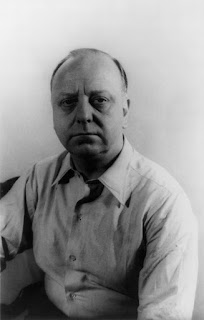
1947 photograph of Virgil Thomson (by Carl Van Vechten, from Wikimedia Commons, no known copyright restrictions)

Readers may recall that this year began with a report on a two-CD set of music by Virgil Thomson released by Everbest Music. This was a reissue as a single package of two albums that had previously been produced by Northeastern Records. To complement this release, this month began with another two-CD release.

This one is an “original,” which has compiled performances of all of the chamber music that Thomson composed. This consists of 63 tracks distributed across two “discs.” The scare quotes have been applied because the content has only been released for digital download, available through an Amazon.com Web page, and the good news is that the full-album download includes the PDF file of a highly-informative 24-page booklet.

Those familiar with the earlier “physical” release will know that, where art song, chamber music, and piano music are concerned, Thomson was basically a miniaturist. Each of the “virtual discs” in this new release consists of a fanfare for trumpets and percussion; and the one that begins the first of the discs is eight seconds long.

This should prepare the listener for the fact that, where chamber music is concerned, Thomson was far from a traditionalist. He did compose two string quartets, both written in 1931 and revised in 1957; and each serves to conclude one of the “virtual discs.” There are also two pieces identified as sonatas, one for violin and piano (composed in 1930) and the other for solo flute (composed in 1943).

More interesting, however, is how many of the selections involve Thomson experimenting with less familiar combinations of instruments. His 1926 sonata da chiesa (church sonata) is scored for clarinet, French horn, trumpet, trombone, and viola. The label was used primarily in the seventeenth-century to distinguish music written for church purposes from those with secular intent. The latter was called sonata da camera, which translates as “chamber music” and subsequently encompassed both sacred and secular intentions. Thomson’s three-movement sonata reflects on these “historical roots,” beginning with a chorale and concluding with a fugue. However, the middle movement is a tango, which is about as conventional as his instrumentation!

The title of the previous release was Portraits, Self-Portraits and Songs. Thomson’s instrumentation for both portraits and self-portraits involved either solo piano or limited chamber resources. As a result, there is some overlap in content across the two releases. However, all of the performances on the new release were recorded during the 2012 Monadnock Music Festival. The album was produced by conductor Gil Rose, who was formerly Artistic Director for Monadnock.

Personally, I have to say that I find the digital domain more conducive to this content than traditional “physical” CDs. The “album” consists of a rather large number of compositions, all of which are relatively short in duration. However, listening to a whole string of them back-to-back is likely to undermine the individual qualities of each selection.

In the digital domain each offering can be taken (or left) on the basis of its own virtues. Put another way, the medium encourages active browsing over passive listening. Since Thomson died on September 30, 1989, he probably never encountered this shift in the listening experience. My guess is that he would have appreciated it; but, because he tended to have a feisty side, he probably would not have owned up to such approval!

Tuesday, January 19, 2021

A Reissue of Two Virgil Thomson Albums

Virgil Thomson on the cover of the album being discussed (courtesy of AMT Public Relations)

This past October Everbest Music released a two-CD set of chamber music by Virgil Thomson, reissuing two albums previously produced by Northeastern Records. The title of the new version is Portraits, Self-Portraits and Songs, and the primary performer is pianist Anthony Tommasini. The original Portraits and Self-Portraits album consists of short pieces, mostly of piano music but also featuring instrumentalists Sharan Leventhal (violin), Fenwick Smith (flute), Frederic T. Cohen (oboe), Ronald Haroutunian (bassoon), and Jonathan Miller (cello). The vocal offerings were taken from Mostly About Love with Tommasini accompanying soprano Nancy Armstrong, mezzo D’Anna Fortunato, tenors Frank Kelley and Paul Kirby, baritone Sanford Sylvan, and bass David Ripley. Percussionist James Russel Smith joins Sylvan and Tommasini for settings of two song texts by William Shakespeare.

Almost all of the selections are relatively brief in duration. Thomson may be best known for the two full-length operas he composed with Gertrude Stein as his librettist, Four Saints in Three Acts and The Mother of Us All. However, in this collection he is a consummate and imaginative miniaturist. The longest uninterrupted offering in the entire set is “Capital Capitals,” again working with a text by Stein. In all of the remaining selections, it is clear that, whether writing for instruments or setting text, Thomson knew what he wanted to say and then knew how to keep silent after he said it.

Thomson was often notorious for his feisty personality. However, he clearly had many friends and no shortage of intimate feelings. Those feelings emerge in these engaging miniatures, making for a highly satisfying listening experience.

Monday, August 3, 2020

MetLiveArts Makes a Mess of Thomson Opera

This past February the expansive space of the Charles Engelhard Court of the Metropolitan Museum of Art hosted four evening performances of the opera The Mother of Us All. This was the second and last partnership of composer Virgil Thomson providing music for a libretto by Gertrude Stein. This was not a partnership in the sense of their previous opera, Four Saints in Three Acts, because Stein died in July of 1946, only a few months after she had sent her libretto to Thomson.

The production was the result of another rich partnership, this one bringing MetLiveArts together with the Juilliard School (for the vocalists) and the New York Philharmonic (for the instrumentalists). Stein’s libretto comes close to requiring a “cast of thousands;” and, to judge by the creative and design team, an equally large mass of individuals was involved in bringing about the performance of the opera itself. Performances took place in the evening because the windows of the Engelhard Court were too vast to be effectively curtained.

Susan B. Anthony (Felicia Moore, right) with Gertrude S. (Libby Sokolowski) (screen shot from the video being discussed)

The basic narrative of Mother of Us All is straightforward. The major character is Susan B. Anthony (soprano Felicia Moore); and the libretto is a chronicle of the women’s suffrage movement that plays fast and loose with the basic historical facts. Anthony is surrounded by a cast that includes those from the distant past (such as President John Adams) and the future (the roles identified as “Gertrude S.” and “Virgil T.”). The text itself is representative of Stein’s delight in wordplay, often taking a phrase and repeating it with a stream of subtle changes in inflection.

Four months ago a video of this production was uploaded to YouTube. The video provided subtitles, which were a significant aid in following Stein’s text. On the basis of the camera angles of the staging, I suspect that those titles may not have been available to the audiences in the Engelhard Court. Even if they were, the staging itself was so cluttered with anarchic imagery that it seems unlikely that anyone at one of those performances would be able to focus on anything. The whole affair emerged as a circus conceived by producers that seemed to have felt great nostalgia for The Living Theatre. The good news is that Moore and many of the other vocalists sang with enough clarity to cut through all of that nonsensical staging. Sadly, the chorus was distributed across the entirety of the Court, meaning that much of the choral work was barely audible.

There is a tendency to dismiss the libretto as Stein’s last gasp of nonsense verse. This seems to have been the opinion of the production team, but even they could not prevent the emergence of semantic clarity that could catch the viewer unawares. This is particularly true of a monologue given to Anthony very early in the second scene of the second act:

Yes but, what is man, what are men, what are they. I do not say that they haven’t kind hearts, if I fall down in a faint, they will rush to pick me up, if my house is on fire, they will rush in to put the fire out and help me, yes they have kind hearts but they are afraid, afraid, they are afraid. They fear women, they fear each other, they fear their neighbor, they fear other countries and then they hearten themselves in their fear by crowding together and following each other, and when they crowd together and follow each other they are brutes, like animals who stampede, and so they have written in the name male into the United States constitution, because they are afraid of black men because they are afraid of women, because they are afraid, afraid. Men are afraid.

Moore’s delivery of that text was, without a doubt, “worth the price of admission” (which was pretty steep for those attending one of the performances).

Thursday, June 11, 2020

A Lighter Side of Virgil Thomson

After yesterday’s article about The Plow That Broke the Plains, I found myself with a desire to write something about a more cheerful side to the music of Virgil Thomson. I decided to continue my pursuit of YouTube uploads of ballet performances, many of which have been provided by John Clifford, formerly a principle dancer with the New York City Ballet and subsequently the founder and Artistic Director of the original Los Angeles Ballet. I selected a ballet that will allow me to flesh out several additional interesting aspects of ballet history, one of which should be of interest to local readers.

The ballet I selected was “Filling Station.” As observed in Balanchine’s New Complete Stories of the Great Ballets, this is “not only one of the first modern ballets on a familiar American subject; but one of the first ballets to employ American music, scenery and costumes by an American, and American dancers.” It was commissioned by Lincoln Kirstein for his Ballet Caravan, which would subsequently become the New York City Ballet, co-founded by Kirstein and George Balanchine. The ballet was given its first performance in 1938 and was revived for the New York City Ballet in 1953.

The YouTube video was made from this revival production. It was shown on a television series called Max Liebman Presents, broadcast on October 10, 1954. Liebman has his own Wikipedia page, on which he is described as the “Ziegfeld of TV;” but it occurred to me that most readers probably know as little about Florenz Ziegfeld Jr. as they do about Max Liebman! A name more familiar to local readers will (hopefully) be that of Lew Christensen, who both choreographed “Filling Station” and danced the leading role of Mac, the filling station attendant, in the original production. He would later come to San Francisco in 1940 when his brother William invited him to become Director of the San Francisco Ballet School, and the two of them would purchase San Francisco Ballet (SFB) in 1942. Lew would remain with SFB until his retirement in 1975.

In the 1953 revival Jacques d’Amboise took over the role of Mac. As Clifford’s notes on the YouTube Web page observed, he was 21 years old at that time; and he is consistently easy-going as he rises to every challenge that Christensen packed into the choreography. Mac is almost entirely the center of attention; and his personality is clearly grounded in the music that Thomson composed for him, “For He’s a Jolly Good Fellow.”

The overall narrative amounts to a day-in-the-life story of the sorts of characters Mac encounters. These include a pair of truck drivers that are Mac’s friends, a state trooper, a clueless motorist that cannot handle directions and has to deal with an overbearing wife and a child with ideas of her own, a pair of “swells” that appear to have enjoyed a “night on the town” experience in broad daylight and are more than a little tipsy, and a gangster. The male “swell” is danced by Todd Bolender, who was a master of choreographed comedy and would later go on to run the Kansas City Ballet and the school associated with the company. The gangster is danced by Richard Thomas, father of “the other Richard Thomas” (who will always be remembered as John-Boy Walton) but also co-founder (with his wife Barbara Fallis) of the New York School of Ballet.

The narrative is more about the personalities than about any action. The only real plot element involves that gangster collecting loot from all of the other patrons of the filling station. There is confusion when Mac turns out the lights, and the stage is filled with flashlights pointing in all directions. When a light is aimed at the gangster, he fires his gun. When the lights come back on, the state trooper has nabbed the gangster; and the female “swell” is lying on the ground. She is carried off in a cortege but waves at Mac before she is taken off the stage.

All this unfolds in only about a quarter of an hour. Nevertheless, in that brief period there is a vast repertoire of choreographic versatility, the only exception being the state trooper, endowed with just the right degree of rigidity by John Mandia. I suppose many present-day viewers might find this more than a little corny; but, however many clichéd rabbits may get pulled out of Christensen’s hat, the intricacy of both the steps and their executions makes this a thoroughly satisfying account of how ballet began to come of age in the United States.

Wednesday, June 10, 2020

The Dark Film Behind Thomson’s “Americana”

At the end of last month, I wrote about how the Detroit Symphony Orchestra (DSO) had organized a “watch party” for the Memorial Day Weekend that featured the six-movement suite of music that Virgil Thomson had composed for Pare Lorentz’ film The Plow That Broke the Plains. At that time I observed that this film was anything but an offering of “celebratory Americana;” and I decided to reject the context of the “watch party” and focus entirely on Thomson’s score, which I viewed through the DSO Replay Web site, which provided a performance on February 8, 2019 at which Leonard Slatkin served as conductor. At that time I observed that Thomson’s score tended to be more upbeat than the film, providing the listener with a variety of familiar folk tunes.

Nevertheless, his arrangement for the suite included several suggestions of ironic rhetoric; and I was left curious as to how the music had been deployed in the film itself. Fortunately, the film is available for viewing on YouTube; and, as expected, watching the film was far less upbeat that listening to the suite. Even when the music accompanies the “rolling text” that introduces the film itself, there are any number of suggestions that there will be little to celebrate in the narrative that will follow. Indeed, the film begins by showing the vast herds of cattle that grazed on the grasslands of the Great Plains, never even suggesting that those cattle had displaced indigenous cultures that had learned, over many generations, how to establish a working relationship with a vast expanse of land where water was scarce and the elements were harsh.


The opening image of The Plow That Broke the Plains (before the credits), showing the homesteaders heading for the Great Plains to replace the cattlemen (screen shot from the video being discussed)

Instead, the first part of the film dwells on advertising whose excessive optimism (is there any other kind in advertising?) encouraged a new generation of Americans to occupy the plains and grow large wheat crops. Indeed, the outbreak of World War I had created a major market for wheat; and Lorentz was not shy about observing how the back-breaking work of the homesteaders was converted into an economic boom, which was basically enjoyed only by the financiers on Wall Street. The film then follows the fate of those homesteaders into the postwar period, when demand dropped radically at the same time that the land itself could no longer sustain the productive farming of wheat. The final blow came with the outbreak of dust storms, after which those previously profit-making plains came to be known as the Dust Bowl.

It is worth noting as a sidebar that Lorenz made his film in 1936. I would like to believe that one of the viewers of that film was John Steinbeck. The Grapes of Wrath was published in 1939; and, for my money at least, it remains one of the best what-happened-next narratives to follow the conclusion of The Plow That Broke the Plains. Neither of these narratives puts our country’s history in a particularly comforting light. By all rights they should have called out the need for us to learn from our mistakes. Sadly, most cultures never rise to that challenge; and, for better or worse, ours has never been an exception to that state of affairs.

Monday, May 25, 2020

The Dark Side of the American Frontier

My latest visit to the DSO Replay Web site of the Detroit Symphony Orchestra (DSO) was motivated by the electronic mail I received about a “watch party” programmed for the Memorial Day weekend. Ostensibly, this was a program of “celebratory Americana;” but those familiar with the planned selections probably knew that the “grand finale” was anything but celebratory. I thus decided to view it in isolation, allowing it more “room” to unfold its dark narrative.

That narrative comes from a 1936 documentary written and directed by Pare Lorentz entitled The Plow That Broke the Plains. Virgil Thomson worked with Lorentz to provide music for the film, after which he compiled a six-movement suite for concert performance. That suite was first performed in the summer of 1946 at a concert by the Hollywood Bowl Symphony Orchestra led by its founder and first conductor, Leopold Stokowski. There is also a four-movement piano version, presumably prepared by Thomson himself, which I was once agile enough to play.

The original version of the suite was conducted by Leonard Slatkin at a concert given on February 8, 2019; and that is the performance that was captured on video for DSO Replay. Between the movements Slatkin read passages that were extracted from the narration for Lorentz’ documentary. The title of the film might lead one to suspect that it was a celebration of the pioneer spirit. However, between Slatkin’s narrations and the titles of the movements, it is clear that this was a far cry from any tub-thumping patriotism.

The titles of the movements provide a useful abstract of the film’s narrative:
  1. Prelude
  2. Pastorale (Grass)
  3. Cattle
  4. Blues (Speculation)
  5. Drought
  6. Devastation
While the narration never acknowledges that the plains to the west of the Mississippi River had indigenous inhabitants, contemporary historical perspective is less kind to that “pioneer spirit” our country used to be so fond of celebrating. The descendants of those that had worked the fields and forests to the east were initially confronted with grasslands that were not suitable for past farming practices. Nevertheless, the pioneers tried to force the land to yield for their own purposes (ignoring, and frequently eliminating, those that had established a more viable relationship with that land). As the title of the fourth movement suggests, those that worked the hardest were often motivated by speculators for whom short-term profit was all that mattered. Ultimately, the film says little about pioneering and much about those circumstances that eventually led to the Dust Bowl.

Monica Fosnaugh playing one of Virgil Thomson’s cor anglais moments (screen shot from the video being discussed)

Thomson’s score never tries to underscore any point that Lorentz tried to make that was best made in text. Instead, the music draws on familiar folk tunes, which Thomson then arranges with enough ironic rhetoric to make it clear that all was not well in the garden (or out on the plains). His approach to instrumentation is particularly inventive, almost as if he was determined to favor instrumentalists that seldom have much to do. Some of those instrumentalists, such as the cor anglais player, benefitted from the video work. Unfortunately, there were also too many shots that were looking in one section of the ensemble while the “action” was taking place somewhere else. Fortunately, even when the camera work was not up to snuff, Slatkin’s sense of balance always allowed the attentive listener to appreciate the full impact of every emotional gesture that Thomson established in his score.

Ultimately, The Plow That Broke the Plains is a film about environmental crisis, making it a valuable object lesson in the context of our current crisis situation.

Thursday, April 12, 2018

Rollicking History Lesson from Other Minds

The title of last night’s program presented by Other Minds as part of Festival 23 was The History Channel. This was definitely truth in advertising. With one exception, all of the works presented on the program covered a span of time between 1914 and 1966; and the only recent offering, given its world premiere, was basically an arrangement of a piece composed in 1930. Taken as a whole, the program was a rollicking account of different approaches to sound poetry that served as a reminder that even the most remote abstractions can exercise a sense of humor.

While it might be unfair to elevate any individual work above all the others, it would probably be fair to say that the major contribution was a performance of Kurt Schwitters’ “Ursonate” (primal sonata) by Jaap Blonk. Intended to demonstrate that one could adapt the traditional form of a sonata to a recitation of vowels and consonants, Schwitters worked on this piece between 1921 and 1932, performing it frequently and developing his score from one performance to the next. What resulted was a four-movement structure beginning with a rondo and then progressing through a largo, a scherzo (with trio), and a presto with finale.

Schwitters was inspired to begin this project after listening to Raoul Hausmann recite his poem “fmsbw;” but it is clear that he was as interested in musical structure as he was in the emerging art form of sound poetry. There is a story (which, if apocryphal, almost begs to be true) that Schwitters once performed his “Ursonate” to an audience of German army officers, who sat there intensely focused on his syllables from beginning to end. Whether this tells us anything about how those officers would subsequently respond to speeches by Adolf Hitler is left as an exercise for the reader.

Nevertheless, I must confess that my own first contact with “Ursonate” (which would have been about twenty years ago) was not that different from that of those Germans. To be fair, that performance was one of an intense declamation, which may have been the same approach that Schwitters had taken with his military audience. Blonk’s performance last night was far more multi-dimensional. He had clearly put much thought into not only shaping every phrase but also endowing each phrase with its own dramatic disposition. However, just as musical rhetoric can startle through abrupt shifts, Blonk’s performance did the same.

One could not “settle in” to listening that focused simply on the rich sonorities of the phrases, because one was always in suspense over the physical manifestation of each phrase. Because there is never any doubt that “Ursonate” is a piece of music that happens to be working with a novel approach to organizing sound, the composition has deservedly earned iconic status in the history of modern music. However, Blonk’s performance made it clear that this was no static icon for worship but a piece of music that invites different approaches to interpretation, just like any sonata by any of the “historically approved” composers.

Less iconic but just as historically significant were the pioneering efforts in sound poetry by the Italian Futurists Filippo Tommaso Marinetti and Fortunato Depero. Enzo Minarelli performed five of these pieces, three by Depero, which were preceded and followed by single selections by Marinetti. What is most interesting about Depero’s creations is that they are basically posters, panoramic images whose shapes and shadings are defined through an ingenious combination of lines and words of different sizes and shapes.

A page from one of Marinetti’s scores for a sound poem (courtesy of Other Minds)

Fortunately, these images, as well as those of the Marinetti compositions, were projected during Minarelli’s performances. Since no specific instructions were provided, performance amounted to a traversal of the image, declaiming the words as the performer progressed along the path. Minarelli presented those words with a clarity that made “score following” relatively easy; but, like Blonk, he had his own techniques for embedding his accounts of those words in an overall rhetorical framework. Thus, regardless of the words he uttered, his delivery of Depero’s “Subway” had unmistakably subterranean connotations as he endowed each word with an acoustic shape that reflected its physical shape on the poster.

The program was distinguished by presenting the United States premiere of the entirety of Ernst Toch’s three-movement suite Gesprochene Musik (spoken music), composed in 1930. The one movement of this suite that has been performed frequently is “Fuge aus der Geographie” (geographical fugue, whose text has an English version, as well as the original German, which was performed last night). In a spirit similar to that of “Ursonate,” Toch developed a rhythmic declamation of geographical places, which are then subjected to imitative polyphonic practices, including the superposition of multiple subjects and the stretto overlapping of voices (but no attempt to provide the subject with a tonal answer).

He also explored specific sound-based approaches to utterance. He thus began with Ratibor (a town that is no longer known by that German name, since it is now in southern Poland, where it is called Racibórz), because rolling the “r” would provide an aural cue to the entrance if the subject. All this was given a thoroughly convincing sense of fugue by the vocal sextet of Amy X Neuburg (soprano), Pamela Z (alto), Kevin Baum and Randall Wong (tenors), Joel Chapman (baritone), and Sidney Chen (bass). (None of those parts had a “pitch range;” but they were still sorted as if such ranges existed.)

The first two movements of the suite amounted to syllabic études, experimenting with different phrasings of vowels and consonants. These pieces were only recently reconstructed from archival materials by Christopher Caines, who created choreography for the entire suite. However, he used the English version of the final fugue. Therefore, last night marked the first time in the United States that the suite was performed entirely in the original German. The suite was followed by a more recent (1962) “Valse,” a setting of mindless cocktail party chatter that offered a delightful account of just how sharp Toch’s wit could be.

Finally, Toch’s grandson, Lawrence Weschler, contributed to the program with “The Medical Fugue,” completed in 2014 and being given its world premiere. Weschler took Toch’s score and changed all the words into medical diseases. As a result, the rolling “r” was replaced by a strongly sibilant “s.” As a result, the fugue subject was announced by the declamation of (you guessed it) “syphilis!”

The program concluded with “Capital Capitals,” Virgil Thomson’s setting of a text written by Gertrude Stein in 1917. Thomson composed his setting in 1927. Those familiar with his score for their joint opera Four Saints in Three Acts will appreciate how “Capital Capitals” introduces many of the devices that Thomson engaged to allow his music to wend its way through Stein’s words. Taken on its own merits, the piece is a bit long-winded; but it still encourages taking a witty approach to Stein’s convoluted texts. The performance was by the vocal quartet of Baum, Wong, Chapman, and Chen, this time accompanied at the piano by Sarah Cahill.

By way of an overture to this piece, the audience got to listen to Stein’s own voice reading her poem “If I told him (a completed portrait of Pablo Picasso).” This definitely prepared the attentive ear for Thomson’s approaches to setting Stein. During the first half there was another recording, this time of Bernard Heidsieck reading “La Poinçonneuse, Passe Partout No. 2,” an account of riding the Paris Metro in earlier days. The remaining selection on the program was Cathy Berberian’s 1966 “Stripsody,” which could be taken as her effort to provide a vocal “reply” to the “Sequenza” composition that her former husband, Luciano Berio, had written for solo female voice. As the title suggests, the piece has as much to do with pop culture as with her thoughts about Berio.

Monday, May 22, 2017

Other Minds Remasters Major Columbia Tapes by Composer-Critics

This past Friday Other Minds Records released its latest album, entitled Composer-Critics of the New York Herald Tribune:

courtesy of Other Minds

This is an essential audio document for anyone interested in the more adventurous side of composition in the United States during the middle decades of the twentieth century. To be fair, however, the backstory of the title is probably as interesting as the music on the album.

The recording comes with a magisterial 60-page booklet edited by Charles Amirkhanian, co-founder of the Other Minds Music Festival, who is also responsible for much of the writing in the booklet. However, I should probably steal a bit of the thunder from this booklet with a quick summary of that backstory. Between 1940 and 1954 Virgil Thomson served as chief music critic for the New York Herald Tribune, which was probably the major (and, where arts reporting was concerned, probably more adventurous) alternative to The New York Times. Thomson had been a highly productive composer in Paris between 1925 and 1940. The Herald Tribune made a shrewd decision in recruiting an “insider;” but, while Thomson had no shortage of strong opinions, he also recognized that his primary obligation to newspaper readers was to provide explanation rather than opinion. (None of this is covered on Thomson’s Wikipedia page, making it my first encounter with a Wikipedia source that is unforgivably inadequate.)

As might be imagined, Thomson was a passionate champion of new music; and he knew enough to avoid directing his efforts strictly to his own compositions. As a result he became connected to many of the rising talents trying to bring their works to public attention while, at the same time, coming up with enough money to get by in New York. Thomson was able to assist by recruiting several of them to take on reviewing jobs, since those were the days when a newspaper still covered more than a single concert in any given issue. Four of the composers he recruited were John Cage, Paul Bowles, Lou Harrison, and Peggy Glanville-Hicks, all of whom had writing skills that measured up to their composing skills.

At that same time Thomson was also approached by Columbia Records to curate a series that would be called Modern American Music. It was no surprise that Thomson would turn to the same composers who were writing for him at the Herald Tribune; and works by all four of Thomson’s subordinates, as well as Thomson himself, would be released on Columbia albums between 1953 and 1955. The new Other Minds album collects from those albums one piece by each of these five composers. In “order of appearance” these pieces are:
  1. Music for a Farce by Bowles
  2. A suite for cello and harp by Harrison
  3. “Capital Capitals,” Thomson’s setting of a text by Gertrude Stein of the same name
  4. A sonata for piano and percussion by Glanville-Hicks
  5. “String Quartet in Four Parts” by Cage
All of these are compositions that have received almost no attention recently, undeservedly so.

Fortunately, those living in my home town of San Francisco were able to enjoy one notable exception to that lack of attention. Because this year marks the centennial of Harrison’s birth, his music is enjoying more exposure than usual; and just this past Saturday his suite was performed as part of a two-concert event entitled Just 100: Homage to Lou Harrison, which happened to be this year’s Other Minds Music Festival! Nevertheless, it would be more than regrettable if any of these composers’ works are only performed on such “significant anniversary” occasions.

The fact is that Other Minds definitely needs to be both recognized and thanked for bringing to light five highly engaging (not to mention strikingly diverse) approaches to composition at a time when the deeply-rooted tree of nineteenth-century traditions was getting a good shaking in any number of different directions. Harrison’s suite, for example, comes across as being both retrospective and prospective at the same time. Three of the movements were originally composed for a film about the Lascaux Cave paintings; and there is a “bare bones” quality to the sonority that almost seems to evoke the earliest efforts at making music. On the other hand, picking up on an observation that Thomson himself made about this piece, the “Air” movement almost sounds as if Harrison took “Le cygne” (the swan) from Camille Saint-Saëns’ The Carnival of the Animals and gave it a good swift kick of twentieth-century rhetoric.

The one piece on this album that I had previously encountered on an album is the Cage quartet, which the Concord String Quartet had recorded for the old vinyl Vox Box American String Quartets of 1950–1970. This was the earliest composition in that collection, since Cage had completed it in 1950; and it predates Cage’s use of chance techniques. It has a subdued and haunting quality that contrasts sharply with both the composer’s pioneering attention to percussion (including his invention of the prepared piano) and the often opaque abstractions that would arise from processes that first identify component materials and then organize them by chance techniques.

“Capital Capitals” may be the piece on this album of major historical interest. It is one of a series of Thomson’s settings of Stein texts, which all seemed to involve their own approaches to synthesizing word-play and sound-play. It was composed in 1927 and is probably the last of those settings that predates Thomson’s first joint project with Stein, which resulted in the opera Four Saints in Three Acts. The text is not included in the booklet, but there is a reproduction of the first page of the published score. One thus quickly sees that the music consists almost entirely of incantation by solo voices; and the words are never in any way distorted by the diction of the four vocalists, tenors Joseph Crawford and Clyde S. Turner, baritone Joseph James, and bass William C. Smith.

Glanville-Hicks is the one composer on the album with a percussion-centric offering. By the time she completed this sonata in 1952, those attending “modern music” concerts would have become used to according soloist status to percussionists. It is therefore more than a little disappointing that the album credits cited only the “NY Percussion Group” (which was probably a pickup group assembled for the recording session), conducted by Carlos Surinach with Carlo Bussotti taking the piano part. Most important is that, for those following how the percussion repertoire had developed since the days of Edgard Varèse’s “Ionisation,” Glanville-Hicks had definitely found a voice uniquely her own for this sonata.

Finally, Music for a Farce is a suite of short pieces that Bowles had written as incidental music for one of Orson Welles’ theatre projects. Like many Welles efforts, this one never came to fruition. Thus, there is no narrative to orient the listener to the eight movements of this suite. Four of them have “social” connotations (tarantella, quickstep, waltz, march). However, the music is best approached as an almost rapid-fire barrage of witticisms, complete with “sound effects” from sources such as a glass milk bottle (which will make this piece a serious challenge for the “original instruments” set).

From a personal point of view, it is difficult for me to listen to this album without serious pangs of nostalgia. Cage is the only composer included whom I got to know for any length of time. (My interaction with Thomson himself probably lasted less than a minute.) At the same time, my nostalgia is assuaged by a rhetoric of fun that pervades the entire album, even when “fun” may not have been what the composer had in mind. I suspect that this particular impression derives from the fact that all five of these composers had a joyous disposition in their respective approaches to modernism, even when the subject matter itself may have been more serious. Furthermore, because we have now become a society that revels in our ignorance of history, this album may be of great service to some of the would-be future composers, who may be in the process of reinventing the wheel without knowing it!

Sunday, March 26, 2017

Håkan Hardenberger will return to SFP as a Virtuosi Series Soloist

[added 4/5, 5:40 p.m.: CANCELLATION NOTICE

Due to family reasons, Håkan Hardenberger is unable to travel abroad. Sadly, that means that he has had to cancel his engagement with San Francisco Performances (SFP). Ticket holders have the options of exchanging for other tickets, receiving a refund, or making a donation to SFP. This can be arranged by calling SFP at 415-398-6449 or by sending electronic mail to tickets@sfperformances.org.]

April is the month in which three of the four concerts in the Virtuosi Series of the San Francisco Performances 2016–2017 season will take place. As was observed this past Thursday, the duo of violinist Alina Ibragimova and pianist Cédric Tiberghien will lead off the month with their second SFP visit as a duo. They will be followed a little over a week later by virtuoso trumpeter Håkan Hardenberger, who will be making his third SFP appearance. He made his SFP debut in 2005 with pianist Aleksander Madzar and returned in 2007 to give a duo recital with percussionist Colin Currie. Next month Hardenberger will be accompanied by pianist Roland Pöntinen, who made his SFP debut in 2007 accompanying clarinetist Martin Fröst.

The major work on the program will be Staffan Storm’s “Three Autumns,” which was commissioned by Musik i Syd for the 2016 Malmö Chamber Music Festival, at which Hardenberger and Pöntinen gave the world premiere performance. The work is a single-movement thirty-minute composition that imposes major technical challenges for both performers. The title refers not to the structure of the work but to its inspiration, the title of a poem by Anna Akhmatova. The poem examines three different senses of autumn; and, while the score mirrors those different senses, those impressions are seamlessly integrated into one uninterrupted movement. This recent composition will be preceded by an earlier work that is still known for its modernism, George Antheil’s four-movement sonata for trumpet, which was first performed in 1954 at Columbia University by pioneering American trumpeter Edna White Chandler.

The second half of the program will feature Pöntinen as both composer and arranger. However, the most familiar selection will be his solo performance of George Gershwin’s three solo piano preludes. His own composition is entitled “L’éléphant rose,” explicitly referring to the “pink elephants on parade” in Walt Disney’s Dumbo. In writing a trumpet part for Hardenberger, Pöntinen drew upon his interest in jazz and his appreciation of the styles of both Miles Davis and Lester Bowie, the latter having become involved in the mid-Sixties with the Association for the Advancement of Creative Musicians in Chicago and then became one of the cofounders of the Art Ensemble of Chicago. The two arrangements on the program are both based in narrative. The first of these draws upon Thomas Newman’s score for the HBO miniseries Angels in America, while the second comes from incidental music for a production of Anton Chekhov’s play The Seagull written by Swedish jazz pianist Jan Lundgren.

The remainder of the second half will feature two Swedish composers and one American. Sweden will be represented by Wilhelm Stenhammar from the nineteenth century and Nils Björkander from the twentieth. The Stenhammar selection is another solo piano composition, the first (in B minor) of the three fantasies he published as his Opus 11 in 1895. Björkander’s “Idyll” is also a piano solo, one of the four short pieces in a collection entitled Skärgårdsskisser (archipelago sketches) composed in 1924. The program will conclude with a concert waltz for trumpet and piano by the American composer Virgil Thomson entitled “At the Beach,” which nostalgically recalls an earlier era of “public music.”

This recital will begin at 7:30 p.m. on Tuesday, April 11. It will take place in Herbst Theatre, located on the ground floor of the Veterans Building at 401 Van Ness Avenue on the southwest corner of McAllister Street. Tickets are being sold for $40 in the balcony, $55 for most of the Dress Circle, and $65 for premium seating. They may be purchased in advance through a City Box Office event page, which shows the Herbst floor plan and which prices apply to which sections. Tickets can also be purchased by calling 415-392-2545, as well as at the Herbst Box Office on the evening of the performance.

Tuesday, July 30, 2013

Total Freedom and Total Control

I was a bit surprised to discover that an Examiner.com article I wrote last week about a free improvisation gig received an impressive number of page views (at least according to Google Analytics). This was a bit ironic since the article itself was very narrow in scope: I chose to "examine" a single set by a single group over the course of a three-set evening. Indeed, I even let the organizers know that I was leaving after that first set, simply because there was too much in my head to risk any of it being crowded out by two more rounds of stimuli.

I now find myself facing another irony. Deutsche Grammophon just released a Complete Works box of the music of Pierre Boulez. (Are they assuming that he has given up composing?) Many of Boulez' earliest pieces involved a highly discipline use of systems to control the specific details of every mark on the score page. I once gave a seminar talk about one of those systems, at the end of which I tried to reconcile the listening experience with all of the detail that had gone into the composing experience.

I have previously cited Virgil Thomson's observation that music composed through a system of absolute control (Boulez) cannot be differentiated from music composed through a system of absolute chance (Cage). (Since writing that post, I discovered that there was a rather extensive exchange of letters between Boulez and Cage at the time that each of them was exploring the possibilities of his systematic approach. There was a good deal of amicable exchange in those letters, but the relationship did not last.) However, I think it is important to remember that "free jazz" is not a matter of turning things over to chance in any systematic manner. Rather, it involves spontaneity in the activity of making music.

The problem is that spontaneity is not easy to achieve. We are always informed by our past activities, and it is virtually impossible to ignore them when we set out to invent something new. I would thus argue that one of the great pioneers of "free improvisation" was Johann Sebastian Bach, whose pedagogical approach was based on the premise that the capacity for invention is tightly coupled to the technical command of execution. On the basis of this premise, I found that I could write about a free improvisation performance in terms of hypotheses as to where the performers had acquired their respective skills of proficiency of execution; and the article turned out to follow and interesting thread running backwards through a few key "stations" in music history. I would not argue that the validity of my hypotheses was not necessarily important. Rather, I found myself advocating the act of hypothesizing as a strategy for listening to free improvisation.

The question now is whether or not such hypothesizing is equally valid as a strategy when total control (by either system or chance) is involved!

Monday, August 22, 2011

Saints Endure

Having just read Jeff Dunn’s review of Four Saints in Three Acts:  An Opera Installation on San Francisco Classical Voice (after having written my own review for Examiner.com and then followed up with a post on this site about the need to see the text of Gertrude Stein while listening to it), I realize that Virgil Thomson’s music has very strong staying power.  Granted, I have always really enjoyed his score.  I used to have the vinyl recording of Thomson’s own abridged version of the full score (which was actually the version performed at this “opera installation”);  and, given the limitations of that physical medium, I probably came close to wearing through the grooves until both sides were unplayable.  Now I have the whole enchilada (so to speak), recorded under the musical direction of Joel Thome;  and I do not have to worry about wearing out the two CDs (although the jewel case was in pretty bad shape from the time it was purchased).

I think that the staying power of the music has a lot to do with its simplicity.  In many ways both melodies and harmonies are about one level more sophisticated than most nursery rhymes.  (For that matter the “all good children go to heaven” text amounts to a sort of nursery rhyme, even if it is a bit less traditional.)  As a result the music roots itself in the cerebral cortex and defies displacement by later input.  In my case the music was in my head after I left the Merola Grand Finale and again this morning when I was preparing to write about Yuri Liberzon’s recital in the Old First Concerts series.  Granted, the Merola ceremonies seemed a bit paler than those of previous seasons;  but Liberzon collaborated with a flutist (Meerenai Shim) for a really stunning suite of tangos by Ástor Piazzolla.  By all rights those tangos should have given Thomson’s music a run for its money;  but Thomson’s Saints had the advantage of strong memory support, while I was hearing the Piazzolla for the first time.

Tomorrow I plan to hear ZOFO do their four-hand performance of Igor Stravinsky’s score for The Rite of Spring.  I have been listening to that music for about a decade before my first exposure to Four Saints.  I even have a copy of the orchestral score that is almost too worn to be handled any more.  That may be just the listening experience to reestablish some cognitive balance!

Saturday, August 20, 2011

The Word's the Thing

As a rule I tend to be a strong supporter of surtitles supplementing opera productions.  This tends to be the case even when the opera is in English, often because it compensates for the impact of proper singing on proper diction.  No titles were employed, however, at the performance of Four Saints in Three Acts, the opera by Virgil Thomson composed for a libretto by Gertrude Stein, which I saw last night and wrote about this morning on Examiner.com.  Thomson wrote music that was perfectly compatible with the qualities of proper diction in the English language, and clarity of diction was one of the great assets of last night’s performance.

Nevertheless, this was a Stein text;  and Stein had a great enthusiasm for the interplay between English as it is written and English as it sounds.  During the preconcert “conversation,” we in the audience were told not to worry if we had trouble finding meaning in the flow of Stein’s words.  Indeed, we were even told that we should feel free to laugh if we found some of the oddities of her constructions funny.  (Did Stein’s supporters really think she needed to be protected against feeling of ridicule?)  However, these supposed authorities never got at the premise that Stein was actually being playful in her writing, and she was at her most ludic when it came to the relations between sounds and text.  (These are, after all, the fundamental relations of opera.  If you are going to commit to writing an opera, you can hardly ignore them.)

Often it is hard to read a Stein text without suppressing the urge to diagram it.  Syntactic structure is part of the game, as is ambiguity of that structure.  Listening to Stein, ambiguity is compounded by the games she plays with homonyms.  Thus, however clear the singers’ diction may be, if you really want to get into what Stein has written, you deserve to see her written text while hearing the singers perform it.  The titles need to be there for the sake of the nature of the written artifact, rather than as compensation for poor diction.  I had some advantage last night from having seen the written text many times, but I still would have preferred to see the titles.

There is an interesting precedent to this approach, by the way;  and it has been around for some time.  Back in 1966 I was fortunate enough to see a pre-release print of a film now listed in IMDb as Passages from James Joyce's Finnegans Wake.  True to its title, it was an effort to dramatize selections from Joyce’s novel involving literal readings of the text for each of those selections.  The whole thing had subtitles.  They were absolutely necessary.  There were too many layers of structure in the text for it to be “processed” by anyone who had not memorized it.  Joyce himself was a singer, so he had a personal appreciation for the relationship between written and sung text.  By watching this film, I appreciated how critical that relationship was to the way he conceived his texts.  Without the subtitles, I would have been totally lost.

Sunday, January 30, 2011

A Coincidence of Contradictions

Milton Babbitt died yesterday at a hospital in Princeton at the age of 94.  I was never a great fan of his music, but this was due in no small part to the sparse opportunities to hear it.  I also suspect that Babbitt had as much right to fall back on the same observation that Arnold Schoenberg once made:

My music is not modern;  it’s just badly played.

Nevertheless, I doubt that anyone would question that there is something very challenging about playing a composition in which the composer can claim a rigorous logical argument behind every note.

However, where this reduction ad absurdum of Schoenberg’s serial techniques is concerned, I think that Virgil Thomson made the right call in one of his pieces in The New York Review.  The article was primarily about John Cage, and Thomson noted Cage taking the opposite strategy that every note in a composition would be determined by a rigorously applied aleatoric process.  (Where Cage was concerned, that process usually involved tossing three coins to select a reading from the I Ching.)  Thomson made the claim that the ear could not tell the difference between a product of absolute logic and one of absolute chance, and I think there is a sound point to make.

The reason probably has to do, once again, with the fact that the music is not in the notes.  It is in the actions that go into making music.  As soon as a composer abstracts away from those actions, there are no perceptual criteria that can distinguish the absolutely determined from the totally random.  Artificial life researchers used to say that this was a phenomenon that occupies just the right middle ground between these two extremes, describing that area as “the edge of chaos.”  I find that more poetic that useful, as if it is yet another way to punt on how little we know about motivated action.

The irony is that the time of Babbitt’s death may have coincided with a concert of compositions by Witold Lutosławski.  The focus of the concert was on works based on aleatoric techniques!  We thus had two events occupying opposite sides of a major aesthetic argument during the twentieth century.  Lutosławski died in 1994;  so I assume he has been waiting patiently in heaven to resume that argument with Babbitt.  I wish both of them well in the afterlife!